—°F Boise, ID
◈ Cross-Vertical Intelligence · Treasure Valley · Boise Standard

Transportation Infrastructure ↔ relates to ↔ Interior Design Architecture

25 Wikipedia bridge articles confirmed in both vertical ledgers. 256 deterministic cross-vertical edges. 6,721 external source links harvested. Every edge provenance-stamped. Every claim auditable.

25 QID Bridge Articles
256 Cross Edges
6,721 External Sources
293 Wikipedia Articles
28 🌲 Evergreen
186 🌿 Branch
HIGH SIGNAL · refinery-treasurevalley-v1.0.0
◈ Machine-Readable Schema
Deterministic Cross-Vertical Summary
PASS 2 · ZERO LLM
Entities Compared
Transportation Infrastructure
× Interior Design Architecture
QID Bridge Articles
25
confirmed Wikipedia overlap
Total Cross Edges
256
External Sources Harvested
6,721
from Wikipedia external links
Geography
Treasure Valley, Ada County, Canyon County, Idaho, United States
Gate Tier
high
Haiku FAQ generated
Strongest Edge
Idaho
score: 1.0000  ·  type: exact_title_cross  ·  32 shared tokens
QID Bridge Titles (20)
IdahoZoningInfrastructureUrbanizationApprenticeshipSupply chainSurveyingBoise State UniversityIrrigationCivil engineeringCollege of Western IdahoTreasure ValleyNampa, IdahoSuburbanizationLand-use planningAmericans with Disabilities Act of 1990Boise, IdahoUrban planningStar, IdahoAda County, Idaho
Shared Semantics (20 tokens)
boiseidahopopulationadalanddevelopmentmetropolitanpublicenvironmentalcapitalpeoplegrowthplanningurbaneconomichealthwatercitiessecondnational
Pipeline
refinery-treasurevalley-v1.0.0
Generated
2026-07-17 23:41:29 UTC
Content Hash
b03f8a5df52c57cc
◈ Wikipedia Bridge Articles
QID Overlap — Confirmed in Both Vertical Ledgers
25 BRIDGES
Idaho
Q1221 EXACT TITLE 1.000
QID OVERLAP: Q1221 in transportation_infrastructure (tier:evergreen) and interior_design_architecture (tier:evergreen). | SHARED TOKENS (32): "agriculture", "approximately", "associated", "boise", "capital", "contains", "distinct", "early", "economy", "idaho", "land", "linked", "manufacturing", "methods", "million", "national", "northwest", "official", "people", "population".... | EXACT TITLE in transportation_infrastructure: "Idaho". | EXACT TITLE in interior_design_architecture: "Idaho".
agricultureapproximatelyassociatedboisecapitalcontainsdistinctearlyeconomyidaholandlinkedmanufacturingmethodsmillionnationalnorthwestofficialpeoplepopulationpriorproductssectorseparatesignificantsmallsuppliestechnologyterritorytourism+2
ches of the Rocky Mountains. The United States Forest Service holds about 38% of Idaho's land, the highest proportion of any state. Industries significant for the state economy include manufacturing, agriculture, mining, forestry, science and technology, and tourism. Idaho has been a predominantly Republican state since statehood, with the Republican Party dominating in both state and national elections; abortion is severely restricted and the state retains the death penalty, including methods like the firing squad. The state contains the Idaho National Laboratory. Idaho's agricultural sector supplies many products, but the state is best known for its potato crop, which comprises around one-third of the nationwide yield.
In 2025, the gross state product (state GDP) for Idaho was $135.5 billion and the state's per capita personal income was $64,846. Idaho had the 39th highest GDP per capita in the United States of America in 2025. In 2025, small businesses made up 99.2% and employed 56.0% of the state's work force. As of May 2025, the state's unemployment rate was 3.6%. Total employment in Idaho in 2024 was 965,824. Idaho is the top potato producing state in the United States and almost one-third of the nation's potatoes are grown in the Snake River Plain, a belt of low-lying land that extends across southern Idaho. Important industries in Idaho are food processing, lumber and wood products, machinery, chemical products, paper products, electronics manufacturing, silver and other mining, and tourism. The world's largest factory for barrel cheese, the raw product for processed cheese, is in Gooding, Idaho. It has a capacity of 120,000 metric tons per year of barrel cheese and belongs to the Glanbia group. As Idaho neared statehood, mining and other extractive industries played a significant role in its economy. Although the state's reliance on mining has diminished over time, Idaho remains renowned as "The Gem State" due to its production of seventy-two varieties of precious and semi-precious stones. Idaho is a leading national producer of potatoes, trout, Austrian winter peas, and lentils. The state's primary industries include manufacturing, agriculture, food processing, timber, and mining. Tourism is another way that Idaho capitalizes on its natural resources.
ce of British Columbia. Idaho's state capital and largest city is Boise. With an area of 83,569 square miles (216,440 km2), Idaho is the 14th-largest state by land area. The state has a population of approximately two million people; it ranks as the 13th-least populous and the seventh-least densely populated of the 50 U.S. states. For thousands of years, and prior to European colonization, Idaho had been inhabited by natives. In the early 19th century, Idaho was considered part of the Oregon Country, an area which was disputed between the U.S. and the British Empire. Idaho officially became a U.S. territory with the signing of the Oregon Treaty of 1846, but a separate Idaho Territory was not organized until 1863, instead being included for periods in Oregon Territory and Washington Territory. The state was eventually admitted to the Union on July 3, 1890, becoming the 43rd state. Forming part of the Pacific Northwest (and the associated Cascadia bioregion), Idaho is divided into several distinct geographic and climatic regions. The state's north, the relatively isolated Idaho Panhandle, is closely linked with Eastern Washington, with which it shares the Pacific Time Zone—the rest of the state uses the Mountain Time Zone. The state's south includes the Snake River Plain (which has most of the population and agricultural land), and the southeast incorporates part of the Great Basin. Idaho is quite mountainous and contains several stretches of the Rocky Mountains. The United States Forest Service holds about 38% of Idaho's land, the highest proportion of any state. Industries significant for the state economy include manufacturing, agriculture, mining, forestry, science and technology, and tourism. Idaho has been a predominantly Republican state since statehood, with the Republican Party dominating in both state and national elections; abortion is severely restricted and the state retains the death penalty, including methods like the firing squad. The state contains the Idaho National Laboratory. Idaho's agricultural sector supplies many products, but the state is best known for its potato crop, which comprises around one-third of the nationwide yield.
Zoning
Q702232 EXACT TITLE 1.000
QID OVERLAP: Q702232 in transportation_infrastructure (tier:evergreen) and interior_design_architecture (tier:evergreen). | SHARED TOKENS (33): "allowing", "building", "buildings", "certain", "density", "developed", "development", "different", "differs", "form", "government", "growth", "guidelines", "industrial", "land", "land-use", "local", "places", "planning", "policy".... | EXACT TITLE in transportation_infrastructure: "Zoning". | EXACT TITLE in interior_design_architecture: "Zoning".
allowingbuildingbuildingscertaindensitydevelopeddevelopmentdifferentdiffersformgovernmentgrowthguidelinesindustriallandland-uselocalplacesplanningpolicypropertyregulationsregulatoryresidentialrulesscaleshapesinglesystemsurban+3
Mixed-use zoning combines residential, commercial, office, and public uses into a single space. Mixed-use zoning can be vertical, within a single building, or horizontal, involving multiple buildings. Planning and community activist Jane Jacobs wrote extensively on the connections between the separation of uses and the failure of urban renewal projects in New York City. She advocated dense mixed-use developments and walkable streets. In contrast to villages and towns, in which many residents know one another, and low-density outer suburbs that attract few visitors, cities and inner city areas have the problem of maintaining order between strangers. This order is maintained when, throughout the day and evening, there are sufficient people present with eyes on the street. This can be accomplished in successful urban districts that have a great diversity of uses, creating interest and attracting visitors. Jacobs' writings, along with increasing concerns about urban sprawl, are often credited with inspiring the New Urbanism movement. To accommodate the New Urbanist vision of walkable communities combining cafés, restaurants, offices and residential development in a single area, mixed-use zones have been created within some zoning systems. These still use the basic regulatory mechanisms of zoning, excluding incompatible uses such as heavy industry or sewage farms, while allowing compatible uses such as residential, commercial and retail activities so that people can live, work and socialise within a compact geographic area. The mixing of land uses is common throughout the world.
Inclusionary zoning refers to policies to increase the number of housing units within a development that are affordable to low and middle-income households. These policies can be mandatory as part of performance zoning or based on voluntary incentives, such as allowing greater density of development. Overlay zoning An overlay zone is a zoning district that overlaps one or more zoning districts to address a particular concern or feature of that area, such as wetlands, historic buildings or transit-oriented development. Overlay zoning has the advantage of providing targeted regulation to address a specific issue, such as a natural hazard, without having to significantly rewrite an existing zoning ordinance.
The United Kingdom does not use zoning as a technique for controlling land use. British land use control began its modern phase after the Town and Country Planning Act of 1947. Rather than dividing municipal maps into land use zones, English planning law places all development under the control of local and regional governments, effectively abolishing the ability to develop land by-right. However, existing development allows land use by-right as long as the use does not constitute a change in the type of land use. A property owner must apply to change land use type of any existing building, and such changes must be consistent with the local and regional land use plans. Development control or planning control is the element of the United Kingdom's system of town and country planning through which local government regulates land use and new building. There are 421 Local Planning Authorities (LPAs) in the United Kingdom. Generally they are the local borough or district council or a unitary authority. They each use a discretionary "plan-led system" whereby development plans are formed and the public consulted. Subsequent development requires planning permission, which will be granted or refused with reference to the development plan as a material consideration. The plan does not provide specific guidance on what type of buildings will be allowed in a given location, rather it provides general principles for development and goals for the management of urban change. Because planning committees (made up of directly elected local councillors) or in some cases planning officers themselves (via delegated decisions) have discretion on each application for development or change of use made, the system is considered a 'discretionary' one. Planning applications can differ greatly in scale, from airports and new towns to minor modifications to individual houses. In order to prevent local authorities from being overwhelmed by high volumes of small-scale applications from individual householders, a separate system of permitted development has been introduced. Permitted development rules are largely form-based, but in the absence of zoning, are applied at the national level. Examples include allowing a two-storey extension up to three metres at the rear of a property, extensions up to 50% of the original width at each side, and certain types of outbuildings in the garden, provided that no more than 50% of the land area is built over. These are appropriately sized for a typical three bedroom semi-detached property, but must be applied across a wide variety of housing types, from small terraces, to larger detached properties and manor houses. In August 2020, the UK Government published a consultation document called Planning for the Future. The proposals hinted at a move toward zoning in England, with areas given a Growth, Renewal or Protected designation, with the possibility of "sub-areas within each category", although the document did not elaborate on what the details of these might have been.
Infrastructure
Q121359 EXACT TITLE 1.000
QID OVERLAP: Q121359 in transportation_infrastructure (tier:evergreen) and interior_design_architecture (tier:evergreen). | SHARED TOKENS (51): "access", "agencies", "airports", "climate", "community", "components", "conditions", "development", "different", "distinct", "economic", "economy", "electrical", "enforcement", "environment", "environmental", "especially", "essential", "facilities", "firms".... | EXACT TITLE in transportation_infrastructure: "Infrastructure". | EXACT TITLE in interior_design_architecture: "Infrastructure".
accessagenciesairportsclimatecommunitycomponentsconditionsdevelopmentdifferentdistincteconomiceconomyelectricalenforcementenvironmentenvironmentalespeciallyessentialfacilitiesfirmsfocusfocusedfunctioninggeneralhealthindustrialindustryinfrastructureinstitutionsinternational+21
l structures such as roads, railways, bridges, airports, public transit systems, tunnels, water supply, sewers, electrical grids, and telecommunications (including Internet connectivity and broadband access). In general, infrastructure has been defined as "the physical components of interrelated systems providing commodities and services essential to enable, sustain, or enhance societal living conditions" and maintain the surrounding environment. Especially in light of the massive societal transformations needed to mitigate and adapt to climate change, contemporary infrastructure conversations frequently focus on sustainable development and green infrastructure. Acknowledging this importance, the international community has created policy focused on sustainable infrastructure through the Sustainable Development Goals, especially Sustainable Development Goal 8 "Industry, Innovation and Infrastructure". One way to describe different types of infrastructure is to classify them as two distinct kinds: hard infrastructure and soft infrastructure. Hard infrastructure is the physical plant and networks necessary for the functioning of a modern industrial society or industry. This includes utilities, waste management, transport facilities, and telecom networks. Soft infrastructure is all the institutions that maintain the economic, health, social, environmental, and cultural standards of a place.
Sustainable energy Sustainable energy infrastructure includes types of renewable energy power plants as well as the means of exchange from the plant to the homes and businesses that use that energy. Renewable energy includes well researched and widely implemented methods such as wind, solar, and hydraulic power, as well as newer and less commonly used types of power creation such as fusion energy. Sustainable energy infrastructure must maintain a strong supply relative to demand, and must also maintain sufficiently low prices for consumers so as not to decrease demand. Any type of renewable energy infrastructure that fails to meet these consumption and price requirements will ultimately be forced out of the market by prevailing non renewable energy sources. Sustainable water Sustainable water infrastructure is focused on a community's sufficient access to clean, safe drinking water. Water is a public good along with electricity, which means that sustainable water catchment and distribution systems must remain affordable to all members of a population. "Sustainable Water" may refer to a nation or community's ability to be self-sustainable, with enough water to meet multiple needs including agriculture, industry, sanitation, and drinking water. It can also refer to the holistic and effective management of water resources.
Masdar City is a proposed zero emission smart city that will be contracted in the United Arab Emirates. Some individuals have referred to this planned settlement as "utopia-like", due to the fact that it will feature multiple sustainable infrastructure elements, including energy, water, waste management, and transportation. Masdar City will have a power infrastructure containing renewable energy methods including solar energy. Masdar City is located in a desert region, meaning that sustainable collection and distribution of water is dependent on the city's ability to use water at innovative stages of the water cycle. The city will use groundwater, greywater, seawater, blackwater, and other water resources to obtain both drinking and landscaping water. Initially, Masdar City will be waste-free. Recycling and other waste management and waste reduction methods will be encouraged. Additionally, the city will implement a system to convert waste into fertilizer, which will decrease the amount of space needed for waste accumulation as well as provide an environmentally friendly alternative to traditional fertilizer production methods. No cars will be allowed in Masdar City, contributing to low carbon emissions within the city boundaries. Instead, alternative transportation options will be prioritized during infrastructure development. This means that a bike lane network will be accessible and comprehensive, and other options will also be available. See also References Bibliography Koh, Jae Myong (2018) Green Infrastructure Financing: Institutional Investors, PPPs and Bankable Projects, London: Palgrave Macmillan. ISBN 978-3-319-71769-2. Nurre, Sarah G.; Cavdaroglu, Burak; Mitchell, John E.; Sharkey, Thomas C.; Wallace, William A. (December 2012). "Restoring infrastructure systems: An integrated network design and scheduling (INDS) problem". European Journal of Operational Research. 223 (3): 794–806. doi:10.1016/j.ejor.2012.07.010. Ascher, Kate (2007). The works: anatomy of a city. Researched by Wendy Marech (Reprint ed.). New York: Penguin Press. ISBN 978-0-14-311270-9. Larry W. Beeferman, "Pension Fund Investment in Infrastructure: A Resource Paper", Capital Matter (Occasional Paper Series), No. 3 December 2008 A. Eberhard, "Infrastructure Regulation in Developing Countries", PPIAF Working Paper No. 4 (2007) World Bank M. Nicolas J. Firzli and Vincent Bazi, "Infrastructure Investments in an Age of Austerity: The Pension and Sovereign Funds Perspective", published jointly in Revue Analyse Financière, Q4 2011 issue, pp. 34–37 and USAK/JTW July 30, 2011 (online edition) Hayes, Brian (2005). Infrastructure: the book of everything for the industrial landscape (1st ed.). New York: Norton. ISBN 978-0-393-32959-9. Huler, Scott (2010). On the grid: a plot of land, an average neighborhood, and the systems that make our world work. Emmaus, PA: Rodale. ISBN 978-1-60529-647-0. Georg Inderst, "Pension Fund Investment in Infrastructure", OECD Working Papers on Insurance and Private Pensions, No. 32 (2009) Dalakoglou, Dimitris (2017). The Road: An Ethnography of (Im)mobility, space and cross-border infrastructures.
Urbanization
Q161078 EXACT TITLE 1.000
QID OVERLAP: Q161078 in transportation_infrastructure (tier:branch) and interior_design_architecture (tier:evergreen). | SHARED TOKENS (56): "approximately", "architecture", "become", "cities", "competitive", "continue", "create", "creates", "current", "describes", "developed", "development", "economic", "economics", "education", "environmental", "equivalent", "essential", "growth", "health".... | EXACT TITLE in interior_design_architecture: "Urbanization".
approximatelyarchitecturebecomecitiescompetitivecontinuecreatecreatescurrentdescribesdevelopeddevelopmenteconomiceconomicseducationenvironmentalequivalentessentialgrowthhealthimpactincreasinginstitutionalinternationallandlargerlinkedlivinglongmajor+26
predicted to generate artificial scarcities of land, lack of drinking water, playgrounds and other essential resources for most urban dwellers. The predicted urban population growth is equivalent to approximately 3 billion urbanites by 2050, much of which will occur in Africa and Asia. Notably, the United Nations has also recently projected that nearly all global population growth from 2017 to 2030 will take place in cities, with about 1.1 billion new urbanites over the next 10 years. In the long term, urbanization is expected to significantly impact the quality of life in negative ways. Urbanization is relevant to a range of disciplines, including urban planning, geography, sociology, architecture, economics, education, statistics, and public health. The phenomenon has been closely linked to globalization, modernization, industrialization, marketization, administrative/institutional power, and the sociological process of rationalization. Urbanization can be seen as a specific condition at a set time (e.g. the proportion of total population or area in cities or towns), or as an increase in that condition over time. Therefore, urbanization can be quantified either in terms of the level of urban development relative to the overall population, or as the rate at which the urban proportion of the population is increasing. Urbanization creates enormous social, economic and environmental challenges, which provide an opportunity for sustainability with the "potential to use resources much less or more efficiently, to create more sustainable land use and to protect the biodiversity of natural ecosystems." However, current urbanization trends have shown that massive urbanization has led to unsustainable ways of living. Developing urban resilience and urban sustainability in the face of increased urbanization is at the centre of international policy in Sustainable Development Goal 11 "Sustainable cities and communities." Urbanization is not merely a modern phenomenon, but a rapid and historic transformation of human social roots on a global scale, whereby predominantly rural culture is being rapidly replaced by predominantly urban culture. The first major change in settlement patterns was the accumulation of hunter-gatherers into villages many thousands of years ago. Village culture is characterized by common bloodlines, intimate relationships, and communal behaviour, whereas urban culture is characterized by distant bloodlines, unfamiliar relations, and competitive behaviour. This unprecedented movement of people is forecast to continue and intensify during the next few decades, mushrooming cities to sizes unthinkable only a century ago.
e long term, urbanization is expected to significantly impact the quality of life in negative ways. Urbanization is relevant to a range of disciplines, including urban planning, geography, sociology, architecture, economics, education, statistics, and public health. The phenomenon has been closely linked to globalization, modernization, industrialization, marketization, administrative/institutional power, and the sociological process of rationalization. Urbanization can be seen as a specific condition at a set time (e.g. the proportion of total population or area in cities or towns), or as an increase in that condition over time. Therefore, urbanization can be quantified either in terms of the level of urban development relative to the overall population, or as the rate at which the urban proportion of the population is increasing. Urbanization creates enormous social, economic and environmental challenges, which provide an opportunity for sustainability with the "potential to use resources much less or more efficiently, to create more sustainable land use and to protect the biodiversity of natural ecosystems." However, current urbanization trends have shown that massive urbanization has led to unsustainable ways of living. Developing urban resilience and urban sustainability in the face of increased urbanization is at the centre of international policy in Sustainable Development Goal 11 "Sustainable cities and communities." Urbanization is not merely a modern phenomenon, but a rapid and historic transformation of human social roots on a global scale, whereby predominantly rural culture is being rapidly replaced by predominantly urban culture. The first major change in settlement patterns was the accumulation of hunter-gatherers into villages many thousands of years ago. Village culture is characterized by common bloodlines, intimate relationships, and communal behaviour, whereas urban culture is characterized by distant bloodlines, unfamiliar relations, and competitive behaviour. This unprecedented movement of people is forecast to continue and intensify during the next few decades, mushrooming cities to sizes unthinkable only a century ago.
Social and cultural effects Social scientists have argued that argued that urbanization influences people's psychology, such as their values, attitudes, and relationships. One line of thinking is that cities tend to have more open, individualistic cultures. For example, US cities tend to have looser, more permissive social norms than rural areas. A study in Japan found that people from rural areas were more likely to take into account how their choice would affect other people. However, some patterns seem to contradict this theory. For instance, when researchers tested social norms across China, people in urban areas reported tighter social norms. In another study, researchers tested the cultural thought style of youth as they moved to college across China. Youngsters who moved from rural areas of China to big cities like Beijing and Shanghai did not show consistent changes in their thought style. Instead, the rice-farming or wheat-farming history of the regions was a stronger predictor of their thought style change, which suggests that cultural histories are living on in modern cities. One possibility is that effects of urbanization on people's psychology differ across cultures. Changing forms Different forms of urbanization can be classified depending on the style of architecture and planning methods as well as the historic growth of areas. In cities of the developed world urbanization traditionally exhibited a concentration of human activities and settlements around the downtown area, the so-called in-migration. In-migration refers to migration from former colonies and similar places. The fact that many immigrants settle in impoverished city centres led to the notion of the "peripheralization of the core", which simply describes that people who used to be at the periphery of the former empires now live right in the centre. Recent developments, such as inner-city redevelopment schemes, mean that new arrivals in cities no longer necessarily settle in the centre. In some developed regions, the reverse effect, originally called counter urbanization has occurred, with cities losing population to rural areas, and is particularly common for richer families. This has been possible because of improved communications and has been caused by factors such as the fear of crime and poor urban environments. It has contributed to the phenomenon of shrinking cities experienced by some parts of the industrialized world. Rural migrants are attracted by the possibilities that cities can offer, but often settle in shanty towns and experience extreme poverty. The inability of countries to provide adequate housing for these rural migrants is related to overurbanization, a phenomenon in which the rate of urbanization grows more rapidly than the rate of economic development, leading to high unemployment and high demand for resources. In the 1980s, this was attempted to be tackled with the urban bias theory which was promoted by Michael Lipton. Most of the urban poor in developing countries unable to find work can spend their lives in insecure, poorly paid jobs.
Apprenticeship
Q20773771 EXACT TITLE 1.000
QID OVERLAP: Q20773771 in transportation_infrastructure (tier:evergreen) and interior_design_architecture (tier:evergreen). | SHARED TOKENS (24): "apprenticeship", "apprenticeships", "boundaries", "certification", "complete", "concept", "continued", "formal", "labor", "license", "master", "people", "period", "placement", "potential", "practice", "practitioners", "professional", "reach", "regulated".... | EXACT TITLE in transportation_infrastructure: "Apprenticeship". | EXACT TITLE in interior_design_architecture: "Apprenticeship".
apprenticeshipapprenticeshipsboundariescertificationcompleteconceptcontinuedformallaborlicensemasterpeopleperiodplacementpotentialpracticepractitionersprofessionalreachregulatedsectorsstudysystemtraining
Apprenticeship is a system for training potential new practitioners of a trade or profession with on-the-job training and often some accompanying study. Apprenticeships may also enable practitioners to gain a license to practice in a regulated occupation. Most of their training is done while working for an experienced employer who helps the apprentices learn their trade or profession, in exchange for their continued labor for an agreed period after they have achieved measurable competencies. Apprenticeship lengths vary significantly across sectors, professions, roles and cultures. In some cases, people who successfully complete an apprenticeship can reach the "journeyman" or professional certification level of competence. In other cases, they can be offered a permanent job at the company that provided the placement.
ing for an experienced employer who helps the apprentices learn their trade or profession, in exchange for their continued labor for an agreed period after they have achieved measurable competencies. Apprenticeship lengths vary significantly across sectors, professions, roles and cultures. In some cases, people who successfully complete an apprenticeship can reach the "journeyman" or professional certification level of competence. In other cases, they can be offered a permanent job at the company that provided the placement.
period after they have achieved measurable competencies. Apprenticeship lengths vary significantly across sectors, professions, roles and cultures. In some cases, people who successfully complete an apprenticeship can reach the "journeyman" or professional certification level of competence. In other cases, they can be offered a permanent job at the company that provided the placement.
Supply chain
Q1824206 EXACT TITLE 1.000
QID OVERLAP: Q1824206 in transportation_infrastructure (tier:evergreen) and interior_design_architecture (tier:evergreen). | SHARED TOKENS (23): "chain", "complex", "consumer", "consumers", "convert", "creating", "direct", "directly", "facilities", "independent", "linked", "logistics", "management", "materials", "network", "product", "products", "structure", "suppliers", "supply".... | EXACT TITLE in transportation_infrastructure: "Supply chain". | EXACT TITLE in interior_design_architecture: "Supply chain".
chaincomplexconsumerconsumersconvertcreatingdirectdirectlyfacilitiesindependentlinkedlogisticsmanagementmaterialsnetworkproductproductsstructuresupplierssupplysystemsystemsvalue
A supply chain is a complex logistics system that consists of facilities that convert raw materials into finished products and distribute them to end consumers or end customers, while supply chain management focuses on the optimization of the flow of goods within the supply chain's distribution channels to ensure efficiency. In sophisticated supply chain systems, the reintroduction of used products into the supply chain may occur at any point where the residual value of the product is recyclable. Supply chains are linked to value chains, and suppliers within a supply chain are often organized into tiers. First-tier suppliers, also referred to as "direct suppliers", directly supply goods or services to the client.
the optimization of the flow of goods within the supply chain's distribution channels to ensure efficiency. In sophisticated supply chain systems, the reintroduction of used products into the supply chain may occur at any point where the residual value of the product is recyclable. Supply chains are linked to value chains, and suppliers within a supply chain are often organized into tiers. First-tier suppliers, also referred to as "direct suppliers", directly supply goods or services to the client.
suppliers", directly supply goods or services to the client. Second-tier suppliers supply to the first tier, and so on, creating a hierarchical structure within the supply network. The phrase "supply chain" may have been first published in a 1905 article in The Independent, which briefly mentioned the difficulty of "keeping a supply chain with India unbroken" during the British expedition to Tibet. Overview
Surveying
Q816425 EXACT TITLE 1.000
QID OVERLAP: Q816425 in transportation_infrastructure (tier:evergreen) and interior_design_architecture (tier:evergreen). | SHARED TOKENS (27): "analysis", "boundaries", "civil", "components", "construction", "development", "digital", "engineering", "environment", "equipment", "establish", "features", "government", "history", "land", "law", "legal", "ownership", "planning", "professional".... | EXACT TITLE in transportation_infrastructure: "Surveying". | EXACT TITLE in interior_design_architecture: "Surveying".
analysisboundariescivilcomponentsconstructiondevelopmentdigitalengineeringenvironmentequipmentestablishfeaturesgovernmenthistorylandlawlegalownershipplanningprofessionalpropertyresearchsalesstructuralsurveyingtransportationwork
es required by government or civil law, such as property sales. A professional in land surveying is called a land surveyor. Surveyors work with elements of geodesy, geometry, trigonometry, regression analysis, physics, engineering, metrology, programming languages, and the law. They use equipment, such as total stations, robotic total stations, theodolites, GNSS receivers, retroreflectors, 3D scanners, lidar sensors, radios, inclinometer, handheld tablets, optical and digital levels, subsurface locators, drones, GIS, and surveying software. Surveying has been an element in the development of the human environment since the beginning of recorded history. It is used in the planning and execution of most forms of construction. It is also used in transportation, communications, mapping, and the definition of legal boundaries for land ownership.
of determining the terrestrial positions of points based on the distances and angles between them. These points are usually on the surface of the Earth, and they are often used to establish maps and boundaries for ownership, locations, such as the designated positions of structural components for construction or the surface location of subsurface features, or other purposes required by government or civil law, such as property sales. A professional in land surveying is called a land surveyor. Surveyors work with elements of geodesy, geometry, trigonometry, regression analysis, physics, engineering, metrology, programming languages, and the law. They use equipment, such as total stations, robotic total stations, theodolites, GNSS receivers, retroreflectors, 3D scanners, lidar sensors, radios, inclinometer, handheld tablets, optical and digital levels, subsurface locators, drones, GIS, and surveying software. Surveying has been an element in the development of the human environment since the beginning of recorded history. It is used in the planning and execution of most forms of construction. It is also used in transportation, communications, mapping, and the definition of legal boundaries for land ownership.
ince the beginning of recorded history. It is used in the planning and execution of most forms of construction. It is also used in transportation, communications, mapping, and the definition of legal boundaries for land ownership.
Boise State University
Q891082 EXACT TITLE 1.000
QID OVERLAP: Q891082 in transportation_infrastructure (tier:evergreen) and interior_design_architecture (tier:evergreen). | SHARED TOKENS (23): "activity", "among", "boise", "business", "college", "compete", "division", "economics", "education", "engineering", "founded", "health", "idaho", "independent", "master", "million", "program", "programs", "public", "reported".... | EXACT TITLE in transportation_infrastructure: "Boise State University". | EXACT TITLE in interior_design_architecture: "Boise State University".
activityamongboisebusinesscollegecompetedivisioneconomicseducationengineeringfoundedhealthidahoindependentmastermillionprogramprogramspublicreportedresearchschooluniversity
, Arts & Sciences, and Education; MPA program in the School of Public Service; and the MPH program in the College of Health Sciences. It is classified among "R2: Doctoral Universities – High research activity".
The university also has an honors college. Within the College of Arts and Sciences is the School of the Environment, approved by the Idaho State Board of Education in 2022 and established in 2023. Boise State's fall enrollment in 2016 was 23,886 students, and approximately 76 percent of these students were Idaho residents. More than 90 percent of Boise State's first-year students come directly from high school. In the 2015–16 school year, Boise State awarded diplomas to 3,916 distinct graduates, including 18 doctorates, 10 education specialists, 670 master's and 2,998 bachelor's degrees. The university is classified among "R2: Doctoral Universities – High research spending and doctorate production".
Boise State University (BSU) is a public research university in Boise, Idaho, United States. Founded in 1932 by the Episcopal Church, it became an independent junior college in 1934 and has been awarding baccalaureate and master's degrees since 1965. It became a public institution in 1969. Boise State offers more than 100 graduate programs, including a variety of MBA programs and the MAcc program in the College of Business and Economics; master's and PhD programs in the Colleges of Engineering, Arts & Sciences, and Education; MPA program in the School of Public Service; and the MPH program in the College of Health Sciences. It is classified among "R2: Doctoral Universities – High research activity".
Irrigation
Q11453 EXACT TITLE 1.000
QID OVERLAP: Q11453 in transportation_infrastructure (tier:evergreen) and interior_design_architecture (tier:evergreen). | SHARED TOKENS (43): "agriculture", "application", "applies", "central", "changes", "conditions", "consolidation", "control", "developed", "directly", "downstream", "drainage", "environmental", "form", "growth", "improvements", "installation", "irrigation", "land", "landscape".... | EXACT TITLE in transportation_infrastructure: "Irrigation". | EXACT TITLE in interior_design_architecture: "Irrigation".
agricultureapplicationappliescentralchangesconditionsconsolidationcontroldevelopeddirectlydownstreamdrainageenvironmentalformgrowthimprovementsinstallationirrigationlandlandscapemanagementmethodsnaturalnetworkoperationoperationspracticepracticespressureproduction+13
Irrigation in agriculture is the practice of applying controlled amounts of water to land to help grow crops, landscape plants, and lawns. Irrigation has been a key aspect of agriculture for over 5,000 years and has been developed by many cultures worldwide. Irrigation helps to grow crops, maintain landscapes, and revegetate disturbed soils in dry areas and during times of below-average rainfall. In addition to these uses, irrigation is also employed to protect crops from frost, suppress weed growth in grain fields, and prevent soil consolidation. It is also used to cool livestock, reduce dust, dispose of sewage, and support mining operations. Drainage, which involves the removal of surface and sub-surface water from a given location, is often studied in conjunction with irrigation. Irrigation and drainage improvements are not necessarily mutually exclusive. Often both may be required together to assure sustained high-level production of crops. For a discussion of the role of drainage practices in agriculture . Several irrigation methods differ in how water is supplied to plants. Surface irrigation, also known as gravity irrigation, is the oldest form of irrigation and has been in use for thousands of years. In sprinkler irrigation, water is piped to one or more central locations within the field and distributed by overhead high-pressure water devices. Micro-irrigation is a system that distributes water under low pressure through a piped network and applies it as a small discharge to each plant. Micro-irrigation uses less pressure and water flow than sprinkler irrigation. Drip irrigation delivers water directly to the root zone of plants. Subirrigation has been used in field crops in areas with high water tables for many years. It involves artificially raising the water table to moisten the soil below the root zone of plants. Irrigation water can come from groundwater (extracted from springs or by using wells), from surface water (withdrawn from rivers, lakes or reservoirs) or from non-conventional sources like treated wastewater, desalinated water, drainage water, or fog collection. Irrigation can be supplementary to rainfall, which is common in many parts of the world as rainfed agriculture, or it can be full irrigation, where crops rarely rely on any contribution from rainfall. Full irrigation is less common and occurs only in arid landscapes with very low rainfall or when crops are grown in semi-arid areas outside the rainy season. The environmental effects of irrigation relate to the changes in quantity and quality of soil and water as a result of irrigation and the subsequent effects on natural and social conditions in river basins and downstream of an irrigation scheme. The effects stem from altered hydrological conditions resulting from the installation and operation of the irrigation scheme. Amongst these problems is the depletion of underground aquifers through overdrafting. Soil can be over-irrigated due to poor distribution uniformity or management wastes water, chemicals, and may lead to water pollution.
nage improvements are not necessarily mutually exclusive. Often both may be required together to assure sustained high-level production of crops. For a discussion of the role of drainage practices in agriculture . Several irrigation methods differ in how water is supplied to plants. Surface irrigation, also known as gravity irrigation, is the oldest form of irrigation and has been in use for thousands of years. In sprinkler irrigation, water is piped to one or more central locations within the field and distributed by overhead high-pressure water devices. Micro-irrigation is a system that distributes water under low pressure through a piped network and applies it as a small discharge to each plant. Micro-irrigation uses less pressure and water flow than sprinkler irrigation. Drip irrigation delivers water directly to the root zone of plants. Subirrigation has been used in field crops in areas with high water tables for many years. It involves artificially raising the water table to moisten the soil below the root zone of plants. Irrigation water can come from groundwater (extracted from springs or by using wells), from surface water (withdrawn from rivers, lakes or reservoirs) or from non-conventional sources like treated wastewater, desalinated water, drainage water, or fog collection. Irrigation can be supplementary to rainfall, which is common in many parts of the world as rainfed agriculture, or it can be full irrigation, where crops rarely rely on any contribution from rainfall. Full irrigation is less common and occurs only in arid landscapes with very low rainfall or when crops are grown in semi-arid areas outside the rainy season. The environmental effects of irrigation relate to the changes in quantity and quality of soil and water as a result of irrigation and the subsequent effects on natural and social conditions in river basins and downstream of an irrigation scheme. The effects stem from altered hydrological conditions resulting from the installation and operation of the irrigation scheme. Amongst these problems is the depletion of underground aquifers through overdrafting. Soil can be over-irrigated due to poor distribution uniformity or management wastes water, chemicals, and may lead to water pollution.
-conventional sources like treated wastewater, desalinated water, drainage water, or fog collection. Irrigation can be supplementary to rainfall, which is common in many parts of the world as rainfed agriculture, or it can be full irrigation, where crops rarely rely on any contribution from rainfall. Full irrigation is less common and occurs only in arid landscapes with very low rainfall or when crops are grown in semi-arid areas outside the rainy season. The environmental effects of irrigation relate to the changes in quantity and quality of soil and water as a result of irrigation and the subsequent effects on natural and social conditions in river basins and downstream of an irrigation scheme. The effects stem from altered hydrological conditions resulting from the installation and operation of the irrigation scheme. Amongst these problems is the depletion of underground aquifers through overdrafting. Soil can be over-irrigated due to poor distribution uniformity or management wastes water, chemicals, and may lead to water pollution.
Civil engineering
Q77590 EXACT TITLE 1.000
QID OVERLAP: Q77590 in transportation_infrastructure (tier:evergreen) and interior_design_architecture (tier:evergreen). | SHARED TOKENS (27): "agencies", "airports", "buildings", "built", "civil", "components", "construction", "departments", "design", "distinguish", "engineering", "environment", "firms", "focused", "government", "infrastructure", "locally", "maintenance", "municipal", "national".... | EXACT TITLE in transportation_infrastructure: "Civil engineering". | EXACT TITLE in interior_design_architecture: "Civil engineering".
agenciesairportsbuildingsbuiltcivilcomponentsconstructiondepartmentsdesigndistinguishengineeringenvironmentfirmsfocusedgovernmentinfrastructurelocallymaintenancemunicipalnationalphysicalprivateprofessionalpublicsectorstructuralsystems
defined to distinguish non-military engineering from military engineering. Civil engineering can take place in the public sector from municipal public works departments through to national government agencies, and in the private sector from locally based firms to Fortune Global 500 companies. History As a discipline Civil engineering is the application of physical and scientific principles for solving the problems of society, and its history is intricately linked to advances in the understanding of physics and mathematics throughout history. Because civil engineering is a broad profession, including several specialized sub-disciplines, its history is linked to knowledge of structures, materials science, geography, geology, soils, hydrology, environmental science, mechanics, project management, and other fields. Throughout ancient and medieval history most architectural design and construction was carried out by artisans, such as stonemasons and carpenters, rising to the role of master builder. Knowledge was retained in craft guilds and seldom supplanted by advances. Structures, roads, and infrastructure that existed were repetitive, and increases in scale were incremental. One of the earliest examples of a scientific approach to physical and mathematical problems applicable to civil engineering is the work of Archimedes in the 3rd century BC, including Archimedes' principle, which underpins our understanding of buoyancy, and practical solutions such as Archimedes' screw.
essional engineering discipline that deals with the design, construction, and maintenance of the physical and naturally built environment, including public works such as roads, bridges, canals, dams, airports, sewage systems, pipelines, structural components of buildings, and railways. Civil engineering is traditionally broken into a number of sub-disciplines. It is considered the second-oldest engineering discipline after military engineering, and it is defined to distinguish non-military engineering from military engineering.
Transportation engineering is concerned with moving people and goods efficiently, safely, and in a manner conducive to a vibrant community. This involves specifying, designing, constructing, and maintaining transportation infrastructure which includes streets, canals, highways, rail systems, airports, ports, and mass transit.
College of Western Idaho
EXACT TITLE 1.000
QID OVERLAP: Q5146875 in transportation_infrastructure (tier:evergreen) and interior_design_architecture (tier:evergreen). | SHARED TOKENS (29): "academic", "ada", "board", "boise", "canyon", "college", "community", "comprehensive", "counties", "cwi", "development", "education", "governed", "idaho", "large", "nampa", "population", "primary", "programs", "public".... | EXACT TITLE in transportation_infrastructure: "College of Western Idaho". | EXACT TITLE in interior_design_architecture: "College of Western Idaho".
academicadaboardboisecanyoncollegecommunitycomprehensivecountiescwidevelopmenteducationgovernedidaholargenampapopulationprimaryprogramspublicreportedservedstudentstudentstechnicaltreasurevalleywesternworkforce
Southern Idaho and North Idaho College, in Idaho and is governed by a five-member board of trustees elected at large by voters in Ada and Canyon counties. CWI offers over 120 programs in the areas of Academic Transfer, Dual Credit, Career and Technical Education, Workforce Development, and Adult Education. In fall of 2023, CWI served 21,359 credit students and 14,951 noncredit students. CWI reported the gender of their students to be 55% female and 45% male.
History Prior to the creation of CWI, Boise was one of the largest metropolitan statistical areas in the United States without a community college. CWI was created on May 22, 2007, when voters of Canyon and Ada counties passed a measure to allow the formation of the new community college district. In June 2007, the Albertson Foundation announced it was donating $10 million to help found the college. In July 2007, the Idaho State Board of Education selected an initial five-member board of trustees. The following month Boise State University faculty member Dennis Griffin was named to a two-year term as the college's first president and CWI began offering academic classes on January 20, 2009, with an enrollment of over 1,100 students. In the summer of 2009 the professional-technical programs from Boise State University's Selland College of Applied Technology transitioned to CWI. By the fall 2009 semester, CWI enrollment had expanded to over 3,600 students. In January 2010, CWI applied for accreditation from the Northwest Commission on Colleges and Universities (NWCCU). NWCCU granted candidacy status at the associate degree level in 2012 and initial accreditation in 2016. President Griffin retired in August 2009 and was succeeded by Bert Glandon. After serving as president for 12 years, Glandon retired from CWI on May 15, 2021. The college's board of trustees named Denise Aberle-Cannata the interim president. CWI Board of Trustees extended an offer to Gordon Jones on Dec. 9, 2021 to be the next president at College of Western Idaho. Gordon Jones accepted the position of President at CWI and began his tenure as the third president in CWI's history on Jan.
Catchment area The college's catchment area includes all of the following counties: Ada, Adams, Boise, Canyon, Gem, Payette, Valley, and Washington. It also includes portions of Elmore and Owyhee counties. Ada and Canyon counties are the taxation zone for the college. Student life CWI has over 30 student clubs and organizations. Student clubs have been created with academic focus as well as special interests. Student groups range from art to physics, horticulture, psychology, Glee, Birdies and Bogies, a Veterans Association, and more. The Associated Students of the College of Western Idaho (ASCWI) serve as the voice of the student body. ASCWI is governed by five officers and eight senators elected by the student body each spring. CWI students participate in competitive, skills-based organizations like Business Professionals of America, SkillsUSA, and Speech and Debate. CWI students have found success at state, regional, and national levels in all three organizations. CWI Speech and Debate captured seven Pi Kappa Delta Community College National Championships in 2011, 2012, 2013, 2015, 2016, 2017, and 2018. Students have earned individual medals at national skills competitions as well. Students have the opportunity to engage on campus through the CWI Presidential Ambassador Program, which promotes leadership and connects students to campus and community events.
Treasure Valley
Q7836726 EXACT TITLE 0.960
QID OVERLAP: Q7836726 in transportation_infrastructure (tier:evergreen) and interior_design_architecture (tier:evergreen). | SHARED TOKENS (13): "association", "boise", "historically", "idaho", "land", "local", "metropolitan", "name", "region", "resources", "treasure", "valley", "western". | EXACT TITLE in transportation_infrastructure: "Treasure Valley". | EXACT TITLE in interior_design_architecture: "Treasure Valley".
associationboisehistoricallyidaholandlocalmetropolitannameregionresourcestreasurevalleywestern
ern Oregon to Boise, and is the most populated area in Idaho. Historically, the valley had been known as the Lower Snake River Valley or the Boise River Valley. Pete Olesen, president of the valley's association of local Chambers of Commerce, coined the name "Treasure Valley" in 1959 to reflect the treasure chest of resources and opportunities that the region offered. The valley has a very diverse terrain, from sage flatlands, to mesas, agricultural areas, and urbanized areas.
The Treasure Valley is a valley in the western United States, primarily in southwestern Idaho, where the Payette, Boise, Weiser, Malheur, and Owyhee rivers drain into the Snake River. It includes all the lowland areas from Vale in rural eastern Oregon to Boise, and is the most populated area in Idaho. Historically, the valley had been known as the Lower Snake River Valley or the Boise River Valley. Pete Olesen, president of the valley's association of local Chambers of Commerce, coined the name "Treasure Valley" in 1959 to reflect the treasure chest of resources and opportunities that the region offered. The valley has a very diverse terrain, from sage flatlands, to mesas, agricultural areas, and urbanized areas.
eflect the treasure chest of resources and opportunities that the region offered. The valley has a very diverse terrain, from sage flatlands, to mesas, agricultural areas, and urbanized areas. As the Boise Metropolitan Area grows, more and more undeveloped and agricultural land is being urbanized. History Settling the region The tribes that roamed the area, specifically, were the Northern Paiute and Shoshone. In 1834, Thomas McKay built the original Fort Boise, in the area near present-day Parma, which was run for a time by Francois Payette. It later was moved because of flooding troubles and was abandoned in 1854. The Oregon Trail runs through the Treasure Valley. The valley was settled for the most part by ranchers and farmers, initially to supply the gold and silver mining communities in the higher elevations nearby: Idaho City in the Boise Basin and Silver City in the Owyhees. A new Fort Boise was constructed by the U.S. Army in 1863 in present-day Boise, from which the city grew.
Nampa, Idaho
Q622633 QID OVERLAP 0.800
QID OVERLAP: Q622633 in transportation_infrastructure (tier:branch) and interior_design_architecture (tier:branch). | SHARED TOKENS (16): "boise", "canyon", "college", "home", "idaho", "meridian", "metropolitan", "name", "nampa", "northwest", "population", "principal", "second", "student", "university", "western".
boisecanyoncollegehomeidahomeridianmetropolitannamenampanorthwestpopulationprincipalsecondstudentuniversitywestern
pa ( ) is the most populous city in Canyon County, Idaho, United States. The population was 100,200 at the 2020 census. It is Idaho's third-most populous city. Nampa is about 20 miles (32 km) west of Boise along Interstate 84, and 6 miles (9.7 km) west of Meridian. It is the second principal city of the Boise metropolitan area. The name "Nampa" may have come from a Shoshoni word meaning 'moccasin' or 'footprint'. According to toponymist William O. Bright, the name comes from the Shoshoni word /nampai/, meaning "foot".
History Nampa had its beginnings in the early 1880s when the Oregon Short Line Railroad built a line from Granger, Wyoming, to Huntington, Oregon, that passed through Nampa. In Nampa there is a history museum that marks the railroad's significance. More railroad lines sprang up through Nampa, making it an important railroad town. Alexander and Hannah Duffes established one of the town's first homesteads, eventually forming the Nampa Land and Improvement Company with the help of their friend and co-founder, James McGee. Despite the name, many early settlers called the town "New Jerusalem" because of its citizens' strong religious focus. After only a year the town grew from 15 homes to 50. As amenities were added, Nampa continued to grow, and it was incorporated in 1891. Downtown Nampa's street grid is oriented with the railroad tracks, which run northwest–southeast; this was done intentionally by Alexander Duffes to prevent accidents like one that occurred earlier in a town he had platted near Toronto, where a woman and her two children were killed by a train when their buggy wheel got stuck as they crossed the tracks. As the Oregon Short Line railroad originally bypassed Boise, Nampa has the fanciest of many railroad depots built in the area. Nampa gained attention in 1889 due to a purported archaeological discovery known as the Nampa figurine. George Frederick Wright wrote up details that year for the Boston Society of Natural History. The first elementary school was built in the 1890s. Lakeview School was on a hill on 6th Street and 12th Avenue North, with a view of Lake Ethel. Just after the school's centennial celebration, it was condemned as a school and sold to the First Mennonite Church. In 2008 the building was refurbished, and it is now used by the Idaho Arts Charter School. Lake Ethel, an irrigation reservoir, had long been the site of community picnics, and many citizens fished, swam, boated, and even hunted on it and its surrounding property. But the hunting didn't last long, as O. F. Persons, owner of the adjoining homestead, took offense when local hunters started shooting his pet ducks. The city later auctioned off the lake. E. H. Dewey (a former Nampa mayor) was the only bidder. But occasional flooding led to a series of lawsuits from neighbors. Dewey eventually drained Lake Ethel. Not long after, the city council became interested in buying back the Fritz Miller property as well as the Dewey home. Pressure had been building for more than four years. Nampa citizens wanted another park. On August 7, 1924, the city council passed an ordinance to purchase the Miller property and name it Lakeview Park. A bandstand was completed in 1928, and the municipal swimming pool opened on August 13, 1934. It is Nampa's largest park and many community celebrations are held there. Colonel William H. Dewey, a man who made a fortune mining in Silver City, built the Dewey Palace Hotel in 1902 for $250,000. He died in his hotel in 1903, leaving his son $1 million. The hotel survived the great fire of 1909, which burned several blocks of downtown Nampa, but was razed in 1963 after redevelopment plans failed. Relics from the hotel such as the chandelier and the hotel safe can be found at the Canyon County Historical Museum, which is in the old train depot on Front Street and Nampa City Hall. After demolition the location on First Street between 11th and 12th Ave. South was sold to private enterprise, including a bank and tire store, replacing this building with modern structures. A public-use postage stamp sized park was later placed across the street from the old palace property as a collaboration between the Downtown Alliance of Nampa (the local business council) and an Eagle Scout Project for the Boy Scouts of America. The park includes a large mural/wall sculpture of running horses commissioned for the project. A Carnegie library was built downtown in 1908; it burned down after the library moved in 1966. Nampa Public Library was then on the corner of 1st Street and 11th Avenue South in the old bank building. A new library, on 12th Avenue South, opened in 2015. Deer Flat Reservoir, an offstream irrigation storage reservoir, was constructed by the United States Bureau of Reclamation between 1906 and 1911. Known locally as Lake Lowell, it is surrounded by the Deer Flat National Wildlife Refuge, established in 1909 by President Theodore Roosevelt. The refuge is administered by the U.S. Fish and Wildlife Service. Lake Lowell is filled by the concrete New York Canal; the water is diverted from the Boise River a few miles below Lucky Peak Dam. In 1910, the Idaho State School and Hospital was built northwest of Nampa for the state's developmentally challenged population. It opened in 1918. The institution was largely self-sufficient, with a large farm staffed by the residents. The higher-functioning residents also cared for residents who could not care for themselves. The land for the farm was sold and is now golf courses (Centennial and Ridgecrest), and the residents no longer give primary care to other residents. The institution is modernized and remains in operation, though a few of the oldest buildings now house juvenile offenders. Nampa held an annual harvest festival and farmers' market from about 1908, a time of celebration and community fun. From this festival emerged the Snake River Stampede Rodeo in 1937, which continues to this day. It is one of the top 12 rodeos in the pro rodeo circuits. In 1913, a local congregation of the Church of the Nazarene built a small elementary school, which became to Northwest Nazarene College in 1915 and finally Northwest Nazarene University. As of 2025, the university has approximately 1,800 undergraduate and graduate students. Karcher Mall opened in 1965, the first enclosed shopping mall in the Treasure Valley. It was "the place to gather" for several decades until the Boise Towne Square mall was built in Boise in 1988, drawing business away. Karcher Mall was renamed District 208 in 2022. The Idaho Press-Tribune is the local newspaper for the Canyon County area.
Idaho Hispanic Community Center (IH2C) In 2003, the Hispanic Cultural Center of Idaho (HCCI) opened thanks to community support. It has recently transitioned back to the City of Nampa and was renamed the Idaho Hispanic Community Center (IH2C) and is home to the Idaho Hispanic Foundation. It hosts events, classes, and festivals, including Día de los Muertos, Hispanic Heritage Month, and Día Internacional de la Mujer. It serves as a meeting place for associations and groups. Displays of cultural history are available to the public. Nampa Train Depot Museum The Nampa Train Depot Museum is a historical depot with displays and archives of the area's railroad and cultural history. The Canyon County Historical Society saved the depot from demolition in 1972. Annual Festival of the Arts Nampa's Festival of the Arts, which began in 1987, is held in Lakeview Park every year and includes local art, music, dance, and food.
Suburbanization
Q1091971 QID OVERLAP 0.800
QID OVERLAP: Q1091971 in transportation_infrastructure (tier:branch) and interior_design_architecture (tier:branch). | SHARED TOKENS (16): "built", "central", "changes", "cities", "demographic", "development", "economic", "environmental", "expansion", "growth", "model", "movement", "planned", "population", "process", "urban".
builtcentralchangescitiesdemographicdevelopmenteconomicenvironmentalexpansiongrowthmodelmovementplannedpopulationprocessurban
Suburbanization (American English), also spelled suburbanisation (British English), is a population shift from historic core cities or rural areas into suburbs. Most suburbs are built in a formation of (sub)urban sprawl. As a consequence of the movement of households and businesses away from city centers, low-density, peripheral urban areas grow. Proponents of curbing suburbanization argue that sprawl leads to urban decay and a concentration of lower-income residents in the inner city, in addition to environmental harm. Suburbanization can be a progressive process in which growing populations, technological innovations, and economic changes drive settlement outward, following the concentric zone model. Suburban growth takes many forms globally including planned satellite towns in Europe, rail-oriented suburbs in East Asia, Canadian high-rises, and the expansion of informal peri-urban areas in the Global South.
Post–World War II economic expansion in the United States included a sudden boom in housing construction as developers raced to address housing shortages across the country. As veterans returned from war, their GI Bill benefits made it especially easy to buy homes in these new, cost-efficient neighborhoods, populating them quickly with young couples and new families. These new neighborhoods were outside the inner city suburbs. This movement away from the inner city to new outer suburbs spawned new "minicites" which have served as smaller centers of economic activity. Racially discriminatory housing policies in many areas prevented people of color from buying homes in the new suburbs, making them largely white-dominated spaces. The nationwide mass migration of white homeowners into the suburbs became known as "white flight". Suburbs are often built around certain industries such as restaurants, shopping, and entertainment, which allows suburban residents to travel less and interact more within the suburban area. For example, Kings County, New York served New York City as farmland in the 18th century, with boats carrying produce across the East River. The steam ferry later made Brooklyn Heights a commuter town for Wall Street. Streetcar suburbs spread through the county, and as elevated railways further extended its reach, the City of Brooklyn grew to fill the county. Areas along the river became industrialized and apartment buildings filled the places where factories did not replace the scattered houses. As a result, much of Brooklyn transformed into a suburban economy and later into an urban economy entirely. The March uptown proceeded similarly on the other side of the East River, and many other suburbs have followed the cycle. Similarly, the rise of modern delivery logistics in postal services, which takes advantage of computerization and the availability of efficient transportation networks, also eliminates some of the advantages that were once to be had from having a business located in the city. Industrial, warehousing, and factory land uses have also moved to suburban areas. This removes the need for company headquarters to be within a quick courier distance of warehouses and ports. Urban areas often suffer from traffic congestion, which creates extra driver costs for the company that may have otherwise been reduced if they were located in a suburban area near a highway instead. Lower property taxes and low land prices encourage selling industrial land for profitable brownfield redevelopment. Suburban areas also offer more land to use as a buffer between industrial areas and residential and retail spaces. This may avoid NIMBY sentiments and gentrification pressure from the local community due to residential and retail areas being adjacent to industrial spaces in an urban area. Suburban municipalities can offer tax breaks, specialized zoning, and regulatory incentives to attract industrial land users to their area, such as City of Industry, California. The overall effect of these developments is that both businesses and individuals now see an advantage to relocating to the suburbs, where the cost of buying land, renting space, and running their operations is cheaper than in the city. This continuing dispersal from a single-city center has led to the advent of edge cities and exurbs, which arise out of clusters of office buildings built in suburban commercial areas, shopping malls, and other high-density developments. With more jobs for suburbanites in these areas rather than in the main city core from which the suburbs grew, traffic patterns have become more complex, with the volume of intra-suburban traffic increasing. Historically, by the year 2000, nearly half of the US population had relocated to suburban areas. In the early 21st century, the spread of communication services, such as broadband, e-mail, and practical home video conferencing, have enabled more people to work from home rather than commuting.
Long-suppressed urbanization and a dramatic housing backlog resulted in extensive peri-urban growth in Tirana (Albania), which during the 1990s doubled the size of the city whereas war refugees put pressure on cities of former Yugoslavia. Elsewhere processes of suburbanization seemed dominant, but their pace differed according to housing shortages, available finances, preferences, and the degree of 'permitted' informality. The process was slow in Prague during the 1990s and more apparent after 2000, when housing affordability improved. Conversely, Slovenian and Romanian suburban developments visibly surrounded cities/towns during the 1990s. Nonetheless, socialist legacies of underdeveloped infrastructure and the affordability crisis of transition differentiate post-socialist suburbs from their Western counterparts. Various degrees of informality characterized suburban housing from illegal occupation of public land (Tirana), illegal construction on agricultural private land (Belgrade) to the unauthorized but later legalized developments in Romania. Suburban housing displayed a chaotic/unplanned character, especially in south-eastern Europe, where the state retains a degree of illegitimacy. Accepting scattered for-profit housing, much of the new detached suburban houses seem self-developed. Allegedly, owner-building has become a household strategy to adapt to recession, high and volatile inflation, to cut construction costs, and to bridge access to housing.
Land-use planning
Q60738778 QID OVERLAP 0.800
QID OVERLAP: Q60738778 in transportation_infrastructure (tier:branch) and interior_design_architecture (tier:branch). | SHARED TOKENS (51): "act", "applicable", "applied", "association", "authority", "behavior", "central", "changes", "cities", "community", "comprehensive", "conditions", "costs", "creating", "depend", "depends", "design", "development", "districts", "economic"....
actapplicableappliedassociationauthoritybehaviorcentralchangescitiescommunitycomprehensiveconditionscostscreatingdependdependsdesigndevelopmentdistrictseconomicenvironmentalessentialfacilitiesfoundedhealthjurisdictionslandland-uselegislationmeans+21
The American Planning Association states that the goal of land use planning is to further the welfare of people and their communities by creating convenient, equitable, healthful, efficient, and attractive environments for present and future generations.
able legislation applicable in Scotland and Northern Ireland. History Land use planning nearly always requires land use regulation, which typically encompasses zoning. Zoning regulates the types of activities that can be accommodated on a given piece of land, as well as the amount of space devoted to those activities, and the ways that buildings may be situated and shaped. The ambiguous nature of the term "planning", as it relates to land use, is historically tied to the practice of zoning. Zoning in the United States came about in the late 19th and early 20th centuries to protect the interests of property owners. The practice was found to be constitutionally sound by the Supreme Court decision of Village of Euclid v. Ambler Realty Co. in 1926. Soon after, the model law known as the Standard State Zoning Enabling Act was enacted by many state legislatures, which gave authority to the states and its subdivisions to regulate land use. Even so, the practice remains controversial today, particularly in its impact on economic and racial segregation, as some critics argue that zoning has often been used to exclude certain populations from particular neighborhoods. The "taking clause" of the Fifth Amendment to the United States Constitution prohibits the government from taking private property for public use without just compensation. The case of Dolan v. City of Tigard demonstrated the criteria that determine the threshold of what is considered taking. One interpretation of the taking clause is that any restriction on the development potential of land through zoning regulation is a "taking". A deep-rooted anti-zoning sentiment exists in America, that no one has the right to tell another what he can or cannot do with his land. Ironically, although people are often averse to being told how to develop their own land, they tend to expect the government to intervene when a proposed land use is undesirable. Conventional zoning has not typically regarded the manner in which buildings relate to one another or the public spaces around them, but rather has provided a pragmatic system for mapping jurisdictions according to permitted land use. This system, combined with the interstate highway system, widespread availability of mortgage loans, growth in the automobile industry, and the over-all post-World War II economic expansion, destroyed most of the character that gave distinctiveness to American cities. The urban sprawl that most US cities began to experience in the mid-twentieth century was, in part, created by a flat approach to land use regulations. Zoning without planning created unnecessarily exclusive zones. Thoughtless mapping of these zones over large areas was a big part of the recipe for suburban sprawl.
As America grew and urban sprawl was rampant, the much-loved America of the older towns, cities, or streetcar suburbs essentially became illegal through zoning. Unparalleled growth and unregulated development changed the look and feel of landscapes and communities. They strained commercial corridors and affected housing prices, causing citizens to fear a decline in the social, economic and environmental attributes that defined their quality of life. Zoning regulations became politically contentious as developers, legislators, and citizens struggled over altering zoning maps in a way that was acceptable to all parties. Land use planning practices evolved as an attempt to overcome these challenges.
Americans with Disabilities Act of 1990
Q1111004 QID OVERLAP 0.800
QID OVERLAP: Q1111004 in transportation_infrastructure (tier:evergreen) and interior_design_architecture (tier:branch). | SHARED TOKENS (25): "accessibility", "act", "ada", "against", "broad", "business", "changes", "civil", "costs", "council", "covered", "effective", "final", "house", "individuals", "january", "later", "law", "national", "provide"....
accessibilityactadaagainstbroadbusinesschangescivilcostscouncilcoveredeffectivefinalhouseindividualsjanuarylaterlawnationalprovidepublicrequirementsrequiresrightssupported
ual orientation and gender identity. In addition, unlike the Civil Rights Act, the ADA also requires covered employers to provide reasonable accommodations to employees with disabilities, and imposes accessibility requirements on public accommodations. In 1986, the National Council on Disability had recommended the enactment of an Americans with Disabilities Act and drafted the first version of the bill which was introduced in the House and Senate in 1988. A broad bipartisan coalition of legislators supported the ADA, while the bill was opposed by business interests (who argued the bill imposed costs on business) and conservative evangelicals (who opposed protection for individuals with HIV). The final version of the bill was signed into law on July 26, 1990, by President George H. W. Bush. It was later amended in 2008 and signed by President George W.
Under Title III, no individual may be discriminated against on the basis of disability with regards to the full and equal enjoyment of the goods, services, facilities, or accommodations of any place of public accommodation by any person who owns, leases, or operates a place of public accommodation. Public accommodations include most places of lodging (such as inns and hotels), recreation, transportation, education, and dining, along with stores, care providers, and places of public displays. Under Title III of the ADA, all new construction (construction, modification or alterations) after the effective date of the ADA (approximately July 1992) must be fully compliant with the Americans With Disabilities Act Accessibility Guidelines (ADAAG) found in the Code of Federal Regulations at 28 C.F.R., Part 36, Appendix A. Title III also has applications to existing facilities. One of the definitions of "discrimination" under Title III of the ADA is a "failure to remove" architectural barriers in existing facilities. See 42 U.S.C. § 12182(b)(2)(A)(iv). This means that even facilities that have not been modified or altered in any way after the ADA was passed still have obligations. The standard is whether "removing barriers" (typically defined as bringing a condition into compliance with the ADAAG) is "readily achievable", defined as "...easily accomplished without much difficulty or expense". The statutory definition of "readily achievable" calls for a balancing test between the cost of the proposed alteration and the wherewithal of the business and/or owners of the business. Thus, what might be "readily achievable" for a sophisticated and financially capable corporation might not be readily achievable for a small or local business. There are exceptions to this title; many private clubs and religious organizations may not be bound by Title III. With regard to historic properties (those properties that are listed or that are eligible for listing in the National Register of Historic Places, or properties designated as historic under state or local law), those facilities must still comply with the provisions of Title III of the ADA to the "maximum extent feasible" but if following the usual standards would "threaten to destroy the historic significance of a feature of the building" then alternative standards may be used. Under 2010 revisions of Department of Justice regulations, newly constructed or altered swimming pools, wading pools, and spas must have an accessible means of entrance and exit to pools for disabled people. However, the requirement is conditioned on whether providing access through a fixed lift is "readily achievable". Other requirements exist, based on pool size, include providing a certain number of accessible means of entry and exit, which are outlined in Section 242 of the standards. However, businesses are free to consider the differences in the application of the rules depending on whether the pool is new or altered, or whether the swimming pool was in existence before the effective date of the new rule.
ADA Amendments Act, 2008 The ADA defines a covered disability as a physical or mental impairment that substantially limits one or more major life activities, a history of having such an impairment, or being regarded as having such an impairment. The Equal Employment Opportunity Commission (EEOC) was charged with interpreting the 1990 law with regard to discrimination in employment. The EEOC developed regulations limiting an individual's impairment to one that "severely or significantly restricts" a major life activity. The ADAAA directed the EEOC to amend its regulations and replace "severely or significantly" with "substantially limits", a more lenient standard. On September 25, 2008, President George W. Bush signed the ADA Amendments Act of 2008 (ADAAA) into law. The amendment broadened the definition of "disability", thereby extending the ADA's protections to a greater number of people. The ADAAA also added to the ADA examples of "major life activities" including, but not limited to, "caring for oneself, performing manual tasks, seeing, hearing, eating, sleeping, walking, standing, lifting, bending, speaking, breathing, learning, reading, concentrating, thinking, communicating, and working" as well as the operation of several specified "major bodily functions". The act overturned a 1999 US Supreme Court case that held that an employee was not disabled if the impairment could be corrected by mitigating measures; it specifically provides that such impairment must be determined without considering such ameliorative measures. It also overturned the court's finding that an impairment that substantially limits one major life activity must also limit others to be considered a disability. In 2008, the United States House Committee on Education and Labor stated that the amendment "makes it absolutely clear that the ADA is intended to provide broad coverage to protect anyone who faces discrimination on the basis of disability." Thus the ADAAA led to broader coverage of impaired employees. Web Content Accessibility Guidelines, 2019 In October 2019, the Supreme Court declined to resolve a circuit split as to whether websites are covered by the ADA. The Court turned down an appeal from Domino's Pizza and let stand a U.S.
Boise, Idaho
Q35775 QID OVERLAP 0.800
QID OVERLAP: Q35775 in transportation_infrastructure (tier:branch) and interior_design_architecture (tier:branch). | SHARED TOKENS (17): "ada", "annual", "boise", "capital", "counties", "downtown", "home", "idaho", "locally", "major", "manufacturing", "metropolitan", "population", "sectors", "technology", "treasure", "valley".
adaannualboisecapitalcountiesdowntownhomeidaholocallymajormanufacturingmetropolitanpopulationsectorstechnologytreasurevalley
Boise (locally also ) is the capital and most populous city in the U.S. state of Idaho. It is the county seat of Ada County. The population of the city was 235,685 at the 2020 census. The Boise metropolitan area, located in the Treasure Valley, includes five counties of Idaho with an estimated population of 846,000, the most populous metropolitan area in Idaho and 95th-most populous in the United States. Located on the Boise River in southwestern Idaho, it is 41 miles (66 km) east of the Oregon border and 110 miles (177 km) north of the Nevada border. Downtown Boise's elevation is 2,704 feet (824 m) above sea level. Boise is home to major employers in the technology, manufacturing, and service sectors, including companies such as Micron Technology and Hewlett-Packard.
an area in Idaho and 95th-most populous in the United States. Located on the Boise River in southwestern Idaho, it is 41 miles (66 km) east of the Oregon border and 110 miles (177 km) north of the Nevada border. Downtown Boise's elevation is 2,704 feet (824 m) above sea level. Boise is home to major employers in the technology, manufacturing, and service sectors, including companies such as Micron Technology and Hewlett-Packard.
...that the military should continue killing Indians 'until the last Indian in the Territories was either on his reservation or enriched the sagebrush with his decaying carcass.' ...if the Indians refused to move there, 'they will be killed or put on the reservation by force, and certainly shot if they don't stay there.' Furthermore, the editor continues, 'The idea that the Indians have any right to the soil is ridiculous. ...They have no more rights to the soil of the Territories of the United States than wolves or coyotes...' This would be our plan of establishing friendship upon an eternal basis with our Indians: Let all the hostile bands of Idaho Territory be called in (they will not be caught in any other manner) to attend a grand treaty; plenty of blankets and nice little trinkets distributed among them; plenty of grub on hand; have a real jolly time with them; then just before the big feast put strychnine in their meat and poison to death the last mother's son of them. At the same time, native warriors around the valley, under the leadership of Howluck also known as "Bigfoot" among white settlers, among others, waged an escalating and intensified guerrilla campaign of harassment of passerby caravans along the Oregon Trail. The United States Army also escalated and intensified "punitive expeditions" against formations of warriors and against civilian communities as well. This marked the start of the "unofficial" Snake War in 1866. This war lasted until 1868, and is statistically the deadliest of the Indian Wars in the West in terms of casualties. In the end, 1,762 men were counted as the casualties of this war from both sides. In 1868, Fort Hall Indian Reservation was established in Southeastern Idaho, about 220 miles upstream, according to the terms of Fort Bridger Treaty. The Boise Valley Shoshone and Bannock Tribes were not party to this treaty. Nevertheless, in April 1869, the United States Military embarked on a campaign of "Removal, rounding up of natives in the region including in and around Boise, and expelling them with cavalry escort to Fort Hall Indian Reservation. This period is known among the Shoshone and Bannock people as Idaho's Trail of Tears. Some of the natives managed to escape, and they ran to either Duck Valley or Fort McDermitt in Nevada. Incorporation and growth Boise's early growth was significantly driven by its role in supplying the nearby gold towns that sprung up in the 1860s northeast and then southwest of the town. Miners sometimes wintered in Boise and a number of early prominent businessmen were miners who settled in town in the years after the gold rush waned. By 1864 substantial agricultural production was underway on easily irrigated lands near the river and three canal companies had been incorporated. Early transportation improvements were largely a result of toll road franchises awarded by the territorial legislature starting in the 1860s. These first ran from Fort Boise to the mining centers in the Boise Basin and east to Rocky Bar and to Rattlesnake Station where they connected to the Oregon Trail. Territorial census records from a special 1864 enumeration list the population of Boise as 1,658, and an act of December 12, 1864, was the first attempt by the Idaho Territorial Legislature to incorporate the city. This was rejected by voters the following March. Two more unsuccessful attempts were made to organize a city administration by election before the 1866 version of the city charter was approved by voters on January 6, 1868. The growing number of homes and businesses, for which owners wanted proper legal title, may have contributed to the eventual success of incorporation. All of these rejected efforts to incorporate the city came after Boise had been controversially made the state capital in 1864 over strong opposition from northern Idaho interests. This decision reflected the rapid shift of population growth from north to south after the discovery of gold in southern Idaho. By 1868 Boise had over 400 permanent buildings with a wide range of commercial services. 1868 also marked the formal beginning of a long advocacy for railroad connections to other Idaho communities and, just as importantly, to other growing cities in the west such as Portland, Oregon. Competing railroad and western state government interests frustrated these efforts for many years. Designed by Alfred B. Mullett, the U.S. Assay Office at 210 Main Street was built in 1871 and today is a National Historic Landmark. It first began accepting gold and silver for purchase on March 2, 1872, largely eliminating the need to transport ore to the mint in San Francisco. A territorial penitentiary, now known as the Old Idaho State Penitentiary, opened the same month several miles east of town. Mining continued to be important to Boise's economic growth and periodic booms contributed to population growth as well, though production of gold and silver probably peaked in the 1860s. 1882's gold and silver production of $3,500,000 declined to $1,488,315 (including lead) by 1899. Boise began to earn its City of Trees nickname in this period with a popular focus on a range of tree planting projects. Thomas J. Davis planted several thousand fruit trees in 1864 and several other early businessmen either founded nurseries or orchards of their own. In the 1870s tree planting began in earnest in downtown Boise led by prominent hotels as well as businessmen and residents. In 1907 Davis donated 43 acres of his orchard property to the city for use as a park in the name of his wife Julia. Commercial agriculture continued to expand, but was slowed by the lack of reliable rail links to regional and national markets and by a lack of large scale irrigation projects, which themselves were often tied to hoped-for railroad projects for financing. A.D. Foote, a successful mining engineer, drew up plans to irrigate up to 500,000 acres immediately south of Boise in 1882, but progress was halting and smaller farms were the norm until after the turn of the century with most located near to the river bottom where soil was productive and irrigation more easily achieved. Fruit orchards proliferated and sugar beets, still an important agricultural industry in Idaho, began to be widely cultivated in the 1890s. Cattle and sheep farming became increasingly important as the century closed. With the exception of dairy, most livestock products were exported from Idaho, unlike other agricultural products which were still largely scaled to support local markets. The timber industry also increasingly thrived in the Boise market in the 1880s and 1890s. Large quantities of timber were exported from elsewhere in Idaho, but a growing Boise supported the expansion of Alexander Rossi's sawmill, first established in 1865. Prominent early Boisean William Ridenbaugh had inherited control of the canal now bearing his name from his uncle William Morris in 1878 and later partnered with Rossi to expand the sawmill capacity under the name Rossi and Ridenbaugh Lumber Company. Their materials supported bridge building and the rapid expansion of Boise in the 1890s. As with many early infrastructure ventures, electrification succeeded only after at least one false start. July 4, 1887, marked the start of electrical transmission from a plant located on the Bench. William Ridenbaugh provided expertise and manpower for the water supply and several months were spent rigging poles and lines from the Bench to the service area across the river. Additional electrical supplies allowed the building of an electric streetcar line in 1891. This ran without interruption until buses replaced the lines in 1927, tracking—and sometimes driving—the development of Boise and nearby communities. This system expanded over several decades, reaching into the North End, South Boise and across the river on Front St. A loop line, completed in 1912, ran as far as Caldwell and Nampa, providing transport throughout the valley. Three early trolley companies merged in 1912 to form the Idaho Traction Company with a depot at 7th and Bannock Streets downtown. Additional services and urban amenities arrived in the 1890s as Boise grew. Exploratory drilling for hot water was successful in 1890 and by the end of the decade many homes along Warm Springs avenue were being heated by this source. A natatorium was built in 1892 close to the source of the hot water near the Idaho State Penitentiary. Churches serving several denominations, a Jewish synagogue, a major hardware store and department store, a Masonic hall, the Columbia Theater, Saint Alphonsus' Hospital, a number of parochial and secular schools, a City Hall and a new Union Pacific passenger station, constructed when service was finally extended to downtown, were all built during the 1890s. Falk's Department Store sponsored a semi-professional baseball team representing Boise from at least 1892 and the city supported other organized sports as they became popular.
Urban planning
Q69883 QID OVERLAP 0.800
QID OVERLAP: Q69883 in transportation_infrastructure (tier:branch) and interior_design_architecture (tier:branch). | SHARED TOKENS (74): "accessibility", "administration", "adopted", "analysis", "another", "architecture", "broader", "buildings", "built", "business", "capital", "category", "cities", "civil", "codes", "community", "creating", "design", "designs", "development"....
accessibilityadministrationadoptedanalysisanotherarchitecturebroaderbuildingsbuiltbusinesscapitalcategorycitiescivilcodescommunitycreatingdesigndesignsdevelopmentdifferentearlyeconomicengineeringenvironmentenvironmentalfocusgrowthhealthimplementation+44
for land use and the built environment, including air, water, and the infrastructure passing into and out of urban areas, such as transportation, communications, and distribution networks, and their accessibility. Traditionally, urban planning followed a top-down approach in master planning the physical layout of human settlements. The primary concern was the public welfare, which included considerations of efficiency, sanitation, protection and use of the environment, as well as taking account of effects of the master plans on the social and economic activities. Over time, urban planning has adopted a focus on the social and environmental "bottom lines" that focuses on using planning as a tool to improve the health and well-being of people and maintain sustainability standards. In the mid-20th century, urban planning experts such as Jane Jacobs called on urban planners to take resident experiences and needs more into consideration. Urban planning answers questions about how people will live, work, and play in a given area and thus, guides orderly development in urban, suburban and rural areas. Although predominantly concerned with the planning of settlements and communities, urban planners are also responsible for planning the efficient transportation of goods, resources, people, and waste. The distribution of basic necessities such as water and electricity; a sense of inclusion and opportunity for people of all kinds, culture and needs; economic growth or business development; improving health and conserving areas of natural environmental significance that actively contribute to reduction in CO2 emissions as well as protecting heritage structures and built environments. Since most urban planning teams consist of highly educated individuals that work for city governments, recent debates focus on how to involve more community members in city planning processes. Urban planning is an interdisciplinary field that includes civil engineering, architecture, human geography, social science and design sciences. Practitioners of urban planning use research and analysis, strategic thinking, engineering architecture, urban design, public consultation, policy recommendations, implementation and management. It is closely related to the field of urban design and some urban planners provide designs for streets, parks, buildings and other urban areas. Urban planners work with the cognate fields of civil engineering, landscape architecture, architecture, and public administration to achieve strategic, policy and sustainability goals. Early urban planners were often members of these cognate fields though in the 21st century, urban planning is a separate, independent professional discipline. The discipline of urban planning is the broader category that includes different sub-fields such as land-use planning, zoning, economic development, environmental planning, and transportation planning. Creating the plans requires a thorough understanding of penal codes and zonal codes of planning. Another important aspect of urban planning is that projects range from the large-scale planning of new towns and Greenfield projects to the transformation and renewal of existing cities, neighborhoods, and public spaces. Pierre Charles L'Enfant and Lúcio Costa are known for planning new capital cities, while Daniel Burnham's Plan of Chicago, Georges-Eugene Haussmann's renovation of Paris, and the urban renewal projects of Robert Moses exemplify the large-scale reshaping of existing urban environments.
urban planners provide designs for streets, parks, buildings and other urban areas. Urban planners work with the cognate fields of civil engineering, landscape architecture, architecture, and public administration to achieve strategic, policy and sustainability goals. Early urban planners were often members of these cognate fields though in the 21st century, urban planning is a separate, independent professional discipline. The discipline of urban planning is the broader category that includes different sub-fields such as land-use planning, zoning, economic development, environmental planning, and transportation planning. Creating the plans requires a thorough understanding of penal codes and zonal codes of planning. Another important aspect of urban planning is that projects range from the large-scale planning of new towns and Greenfield projects to the transformation and renewal of existing cities, neighborhoods, and public spaces. Pierre Charles L'Enfant and Lúcio Costa are known for planning new capital cities, while Daniel Burnham's Plan of Chicago, Georges-Eugene Haussmann's renovation of Paris, and the urban renewal projects of Robert Moses exemplify the large-scale reshaping of existing urban environments.
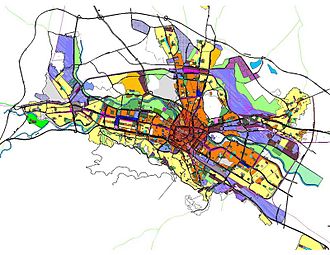
rations of efficiency, sanitation, protection and use of the environment, as well as taking account of effects of the master plans on the social and economic activities. Over time, urban planning has adopted a focus on the social and environmental "bottom lines" that focuses on using planning as a tool to improve the health and well-being of people and maintain sustainability standards. In the mid-20th century, urban planning experts such as Jane Jacobs called on urban planners to take resident experiences and needs more into consideration. Urban planning answers questions about how people will live, work, and play in a given area and thus, guides orderly development in urban, suburban and rural areas. Although predominantly concerned with the planning of settlements and communities, urban planners are also responsible for planning the efficient transportation of goods, resources, people, and waste. The distribution of basic necessities such as water and electricity; a sense of inclusion and opportunity for people of all kinds, culture and needs; economic growth or business development; improving health and conserving areas of natural environmental significance that actively contribute to reduction in CO2 emissions as well as protecting heritage structures and built environments. Since most urban planning teams consist of highly educated individuals that work for city governments, recent debates focus on how to involve more community members in city planning processes. Urban planning is an interdisciplinary field that includes civil engineering, architecture, human geography, social science and design sciences. Practitioners of urban planning use research and analysis, strategic thinking, engineering architecture, urban design, public consultation, policy recommendations, implementation and management. It is closely related to the field of urban design and some urban planners provide designs for streets, parks, buildings and other urban areas. Urban planners work with the cognate fields of civil engineering, landscape architecture, architecture, and public administration to achieve strategic, policy and sustainability goals. Early urban planners were often members of these cognate fields though in the 21st century, urban planning is a separate, independent professional discipline. The discipline of urban planning is the broader category that includes different sub-fields such as land-use planning, zoning, economic development, environmental planning, and transportation planning. Creating the plans requires a thorough understanding of penal codes and zonal codes of planning. Another important aspect of urban planning is that projects range from the large-scale planning of new towns and Greenfield projects to the transformation and renewal of existing cities, neighborhoods, and public spaces. Pierre Charles L'Enfant and Lúcio Costa are known for planning new capital cities, while Daniel Burnham's Plan of Chicago, Georges-Eugene Haussmann's renovation of Paris, and the urban renewal projects of Robert Moses exemplify the large-scale reshaping of existing urban environments.
Star, Idaho
Q1516815 QID OVERLAP 0.780
QID OVERLAP: Q1516815 in transportation_infrastructure (tier:branch) and interior_design_architecture (tier:branch). | SHARED TOKENS (14): "ada", "boise", "canyon", "district", "house", "idaho", "metropolitan", "name", "population", "rapidly", "school", "schools", "shared", "star".
adaboisecanyondistricthouseidahometropolitannamepopulationrapidlyschoolschoolssharedstar
Star is a city in northwestern Ada County, Idaho, with parts stretching into neighboring Canyon County. The population was 11,117 at the 2020 census, up from 5,793 in 2010. It was named in the 19th century by travelers on their way to Middleton and Boise who used the star on the school house to find east and west. The name stuck and it became Star, Idaho.
on the school house to find east and west. The name stuck and it became Star, Idaho. Today, it is a rapidly growing suburb of Boise and its schools are shared with Middleton School District and West Ada School District. Star is part of the Boise metropolitan area. Geography Star is located at 43°41′39″N 116°29′25″W (43.694084, -116.490225), at an elevation of 2,470 feet (753 m) above sea level.
2000 census As of the census of 2000, there were 1,795 people in 631 households, including 485 families, in the city. The population density was 2,092.5 inhabitants per square mile (807.9/km2). There were 681 housing units at an average density of 793.9 per square mile (306.5/km2). The racial makeup of the city was 92.87% White, 0.28% African American, 0.95% Native American, 0.22% Asian, 0.06% Pacific Islander, 0.89% from other races, and 4.74% from two or more races. Hispanic or Latino of any race were 4.29%. Of the 631 households 48.0% had children under the age of 18 living with them, 60.2% were married couples living together, 11.7% had a female householder with no husband present, and 23.1% were non-families. 16.8% of households were one person and 4.1% were one person aged 65 or older. The average household size was 2.82 and the average family size was 3.19. The age distribution was 33.2% under the age of 18, 9.9% from 18 to 24, 36.4% from 25 to 44, 14.8% from 45 to 64, and 5.7% 65 or older. The median age was 28 years. For every 100 females, there were 97.0 males. For every 100 females age 18 and over, there were 92.8 males. The median household income was $42,337 and the median family income was $46,458. Males had a median income of $31,028 versus $22,625 for females. The per capita income for the city was $15,864. About 5.4% of families and 8.5% of the population were below the poverty line, including 10.7% of those under age 18 and 13.6% of those age 65 or over. Education All of Star in Ada County is in the West Ada School District (Meridian Joint School District 2).
Ada County, Idaho
Q109820 QID OVERLAP 0.780
QID OVERLAP: Q109820 in transportation_infrastructure (tier:evergreen) and interior_design_architecture (tier:evergreen). | SHARED TOKENS (14): "ada", "boise", "capital", "district", "home", "idaho", "jurisdiction", "local", "metropolitan", "northwest", "population", "private", "second", "streets".
adaboisecapitaldistricthomeidahojurisdictionlocalmetropolitannorthwestpopulationprivatesecondstreets
Ada County is located in the southwestern part of Idaho, United States. As of the 2020 census, the county had a population of 494,967, which by 2025 was estimated to have risen to 546,141. Ada County is by far the state's most populous county; it is home to 26.8% of the state's population. The county seat and largest city is Boise, which is also the state capital. Ada County is included in the Boise metropolitan area. The Ada County Highway District has jurisdiction over all the local county and city streets, except for private roads and state roads.
populous county; it is home to 26.8% of the state's population. The county seat and largest city is Boise, which is also the state capital. Ada County is included in the Boise metropolitan area. The Ada County Highway District has jurisdiction over all the local county and city streets, except for private roads and state roads.
ea. The Ada County Highway District has jurisdiction over all the local county and city streets, except for private roads and state roads. In the interior Pacific Northwest east of the Cascade Range, Ada County ranks second in population, behind Spokane County, Washington. History Ada County was created by the Idaho Territory legislature on December 22, 1864, partitioned from Boise County. It is named for Ada Riggs, the daughter of H. C. Riggs, a member of the legislature; he established the county and was a co-founder of Boise.
Garden City, Idaho
QID OVERLAP 0.760
QID OVERLAP: Q1516892 in transportation_infrastructure (tier:evergreen) and interior_design_architecture (tier:evergreen). | SHARED TOKENS (13): "ada", "boise", "garden", "government", "idaho", "metropolitan", "municipal", "name", "nearly", "population", "second", "separate", "street".
adaboisegardengovernmentidahometropolitanmunicipalnamenearlypopulationsecondseparatestreet
Garden City is a city in Ada County, Idaho. The population was 12,316 at the time of the 2020 census. Garden City is nearly surrounded by Boise but retains a separate municipal government. Garden City was named for gardens raised by Chinese immigrants who lived in the area.
Geography According to the United States Census Bureau, the city has a total area of 4.17 square miles (10.80 km2), of which 4.04 square miles (10.46 km2) is land and 0.13 square miles (0.34 km2) is water. Expo Idaho, which hosts the Western Idaho Fair, is part of unincorporated Ada County but the city limits completely surround the complex. In 2017, Mayor John Evans proposed that Garden City annex the enclave in order to develop a downtown area. Demographics 2020 census As of the 2020 census, Garden City had a population of 12,316. The median age was 47.0 years. 16.9% of residents were under the age of 18 and 26.4% of residents were 65 years of age or older. For every 100 females there were 92.1 males, and for every 100 females age 18 and over there were 90.5 males age 18 and over. 100.0% of residents lived in urban areas, while 0.0% lived in rural areas. There were 5,585 households in Garden City, of which 21.4% had children under the age of 18 living in them. Of all households, 40.2% were married-couple households, 21.5% were households with a male householder and no spouse or partner present, and 30.1% were households with a female householder and no spouse or partner present. About 33.1% of all households were made up of individuals and 16.8% had someone living alone who was 65 years of age or older. There were 5,927 housing units, of which 5.8% were vacant.
2000 census At the 2000 census there were 10,624 people, 4,331 households, and 2,784 families living in the city. The population density was 2,559.9 per square mile. There were 4,590 housing units at an average density of 1,106.0 per square mile. The racial makeup of the city was 89.3% White, 0.5% African American, 0.9% Native American, 1.4% Asian, 0.1% Pacific Islander, 4.9% from other races, and 2.9% from two or more races. Hispanic or Latino of any race were 9.6%. Of the 4,331 households 29.8% had children under the age of 18 living with them, 47.7% were married couples living together, 10.9% had a female householder with no husband present, and 35.7% were non-families. 27% of households were one person and 8.3% were one person aged 65 or older. The average household size was 2.43 and the average family size was 2.91. The age distribution was 24.3% under the age of 18, 10.8% from 18 to 24, 29.9% from 25 to 44, 22.6% from 45 to 64, and 12.5% 65 or older. The median age was 35 years. For every 100 females, there were 103.1 males. For every 100 females age 18 and over, there were 101.3 males. The median household income was $38,520 and the median family income was $46,463. Males had a median income of $30,499 versus $28,315 for females. The per capita income for the city was $24,242. About 9.8% of families and 12.7% of the population were below the poverty line, including 16.6% of those under age 18 and 4.0% of those age 65 or over. Education Most of Garden City is in Boise School District.
Meridian, Idaho
Q1085274 QID OVERLAP 0.700
QID OVERLAP: Q1085274 in transportation_infrastructure (tier:branch) and interior_design_architecture (tier:branch). | SHARED TOKENS (10): "ada", "among", "boise", "capital", "cities", "idaho", "making", "meridian", "population", "second".
adaamongboisecapitalcitiesidahomakingmeridianpopulationsecond
Meridian is a city located in Ada County, Idaho, United States. The population was 117,635 at the 2020 census, making it the second most populous city in the county and Idaho, after Boise, the state capital.
Rail transportation (1908–28) Following the raising of $4,000 to lay the Interurban rail line from Onweiler (Meridian and Ustick Roads), the tracks were completed into the village center. Turning east on Broadway and ending at East Second, the last car would spend the night in Meridian before returning to Boise early the next morning with passengers and freight. The interurban Station and Generator building (west one-third of the old library at Meridian and Idaho Streets) was built in 1912, and the line continued on to Nampa via Meridian. The tracks down Broadway were not used after 1912. The Interurban Company entered into receivership and closed in 1928 after 20 years of providing continuous transportation to neighboring towns. It was Meridian's main connection to the area outside the local community. The Union Pacific Railroad spur opened in 1900 and is currently operated by the Boise Valley Railroad. Many industrial customers continue to ship forest, agricultural, and chemical products along this corridor. Creamery (1929–70) The city's official website describes the history of the Ada County Dairymen's cooperative creamery as follows:The lowest days of the Great Depression brightened for area dairymen when the Ada County Dairymen's cooperative creamery began operation in 1929. It provided milk checks to those who were members of the cooperative, enabling them to pay their taxes and provide food for their families. Other community members hauled milk to the creamery and were employed by the creamery, whose product was Challenge Butter. The creamery ran seven days a week for 40 years. Additions and improvements were made while the plant was in full operation. Later years saw the Wyeth Laboratories affiliate with the creamery to manufacture SMA baby formula.
Creamery (1929–70) The city's official website describes the history of the Ada County Dairymen's cooperative creamery as follows:The lowest days of the Great Depression brightened for area dairymen when the Ada County Dairymen's cooperative creamery began operation in 1929. It provided milk checks to those who were members of the cooperative, enabling them to pay their taxes and provide food for their families. Other community members hauled milk to the creamery and were employed by the creamery, whose product was Challenge Butter. The creamery ran seven days a week for 40 years. Additions and improvements were made while the plant was in full operation. Later years saw the Wyeth Laboratories affiliate with the creamery to manufacture SMA baby formula.
Caldwell, Idaho
Q849592 QID OVERLAP 0.680
QID OVERLAP: Q849592 in transportation_infrastructure (tier:branch) and interior_design_architecture (tier:branch). | SHARED TOKENS (9): "approximately", "boise", "caldwell", "canyon", "college", "idaho", "locally", "metropolitan", "population".
approximatelyboisecaldwellcanyoncollegeidaholocallymetropolitanpopulation
city in Idaho. As of the 2020 census, Caldwell had a population of 59,996. Caldwell is considered part of the Boise metropolitan area, and is the location of the College of Idaho. The city is located approximately 24 miles (39 km) west of Boise, and approximately 17 miles (27 km) east of the Oregon border. History The present-day location of Caldwell is along a natural passageway to the Inland and Pacific Northwest. Native American tribes from the west coast, north Idaho and as far away as Colorado came to the banks of the Boise River for annual trading fairs, or rendezvous. European and some Hawaiian explorers and traders soon followed the paths left by Native Americans and hopeful emigrants later forged the Oregon Trail and followed those paths to seek a better life in the Oregon Territory. Pioneers of the Trail traveled along the Boise River to Canyon Hill and forded the river close to the Silver Bridge on Plymouth Street. During the Civil War, the discovery of gold in Idaho's mountains brought a variety of new settlers into the area. Many never made it to the mines but settled along the Boise River and run ferries, stage stations, and freighting businesses. These early entrepreneurs created small ranches and farms in the river valleys. Caldwell's inception occurred largely as a result of the construction of the Oregon Short Line Railroad, which connected Wyoming to Oregon through Idaho. Robert E. Strahorn came to the Boise River Valley in 1883 to select a route for the railroad. He rejected the grade into Boise City as too steep and chose a site 30 miles to the west. He drove a stake into an alkali flat of sagebrush and greasewood and the City of Caldwell was platted. Caldwell was named after one of Strahorn's business partners, Alexander Caldwell, a former senator from Kansas. When Caldwell was platted in August 1883, its founder, the Idaho and Oregon Land Improvement Company, started persuading settlers and businessmen to move to the area. Within four months, Caldwell had 600 residents living in 150 dwellings, 40 businesses, a school, a telephone exchange, and two newspapers. On January 15, 1890, the Board of Commissioners of Ada County issued a handwritten order incorporating the City of Caldwell. The College of Idaho was founded in Caldwell in 1891. In 1892, Canyon County was established from a portion of Ada County, and Caldwell was named the county seat. Irrigation canals and waterways were constructed throughout Canyon County, providing the foundation for an agricultural economy. The Oregon Short Line Railroad became part of the larger Union Pacific Railroad network and in 1906 the Caldwell freight and passenger depot was constructed. Caldwell experienced moderate growth as an agricultural processing, commercial retail and educational center during the 20th century. In 2009, the City of Caldwell completed a revitalization project to restore Indian Creek, which runs through downtown Caldwell, but had been used for sewage disposal by local industries and been covered over.
History The present-day location of Caldwell is along a natural passageway to the Inland and Pacific Northwest. Native American tribes from the west coast, north Idaho and as far away as Colorado came to the banks of the Boise River for annual trading fairs, or rendezvous. European and some Hawaiian explorers and traders soon followed the paths left by Native Americans and hopeful emigrants later forged the Oregon Trail and followed those paths to seek a better life in the Oregon Territory. Pioneers of the Trail traveled along the Boise River to Canyon Hill and forded the river close to the Silver Bridge on Plymouth Street. During the Civil War, the discovery of gold in Idaho's mountains brought a variety of new settlers into the area. Many never made it to the mines but settled along the Boise River and run ferries, stage stations, and freighting businesses. These early entrepreneurs created small ranches and farms in the river valleys. Caldwell's inception occurred largely as a result of the construction of the Oregon Short Line Railroad, which connected Wyoming to Oregon through Idaho. Robert E. Strahorn came to the Boise River Valley in 1883 to select a route for the railroad. He rejected the grade into Boise City as too steep and chose a site 30 miles to the west. He drove a stake into an alkali flat of sagebrush and greasewood and the City of Caldwell was platted. Caldwell was named after one of Strahorn's business partners, Alexander Caldwell, a former senator from Kansas. When Caldwell was platted in August 1883, its founder, the Idaho and Oregon Land Improvement Company, started persuading settlers and businessmen to move to the area. Within four months, Caldwell had 600 residents living in 150 dwellings, 40 businesses, a school, a telephone exchange, and two newspapers. On January 15, 1890, the Board of Commissioners of Ada County issued a handwritten order incorporating the City of Caldwell. The College of Idaho was founded in Caldwell in 1891. In 1892, Canyon County was established from a portion of Ada County, and Caldwell was named the county seat. Irrigation canals and waterways were constructed throughout Canyon County, providing the foundation for an agricultural economy. The Oregon Short Line Railroad became part of the larger Union Pacific Railroad network and in 1906 the Caldwell freight and passenger depot was constructed. Caldwell experienced moderate growth as an agricultural processing, commercial retail and educational center during the 20th century. In 2009, the City of Caldwell completed a revitalization project to restore Indian Creek, which runs through downtown Caldwell, but had been used for sewage disposal by local industries and been covered over.
location of the College of Idaho. The city is located approximately 24 miles (39 km) west of Boise, and approximately 17 miles (27 km) east of the Oregon border. History The present-day location of Caldwell is along a natural passageway to the Inland and Pacific Northwest. Native American tribes from the west coast, north Idaho and as far away as Colorado came to the banks of the Boise River for annual trading fairs, or rendezvous. European and some Hawaiian explorers and traders soon followed the paths left by Native Americans and hopeful emigrants later forged the Oregon Trail and followed those paths to seek a better life in the Oregon Territory. Pioneers of the Trail traveled along the Boise River to Canyon Hill and forded the river close to the Silver Bridge on Plymouth Street. During the Civil War, the discovery of gold in Idaho's mountains brought a variety of new settlers into the area. Many never made it to the mines but settled along the Boise River and run ferries, stage stations, and freighting businesses. These early entrepreneurs created small ranches and farms in the river valleys. Caldwell's inception occurred largely as a result of the construction of the Oregon Short Line Railroad, which connected Wyoming to Oregon through Idaho. Robert E. Strahorn came to the Boise River Valley in 1883 to select a route for the railroad. He rejected the grade into Boise City as too steep and chose a site 30 miles to the west. He drove a stake into an alkali flat of sagebrush and greasewood and the City of Caldwell was platted. Caldwell was named after one of Strahorn's business partners, Alexander Caldwell, a former senator from Kansas. When Caldwell was platted in August 1883, its founder, the Idaho and Oregon Land Improvement Company, started persuading settlers and businessmen to move to the area. Within four months, Caldwell had 600 residents living in 150 dwellings, 40 businesses, a school, a telephone exchange, and two newspapers. On January 15, 1890, the Board of Commissioners of Ada County issued a handwritten order incorporating the City of Caldwell. The College of Idaho was founded in Caldwell in 1891. In 1892, Canyon County was established from a portion of Ada County, and Caldwell was named the county seat. Irrigation canals and waterways were constructed throughout Canyon County, providing the foundation for an agricultural economy. The Oregon Short Line Railroad became part of the larger Union Pacific Railroad network and in 1906 the Caldwell freight and passenger depot was constructed. Caldwell experienced moderate growth as an agricultural processing, commercial retail and educational center during the 20th century. In 2009, the City of Caldwell completed a revitalization project to restore Indian Creek, which runs through downtown Caldwell, but had been used for sewage disposal by local industries and been covered over.
Kuna, Idaho
Q1515177 QID OVERLAP 0.660
QID OVERLAP: Q1515177 in transportation_infrastructure (tier:branch) and interior_design_architecture (tier:branch). | SHARED TOKENS (8): "ada", "additional", "boise", "idaho", "kuna", "metropolitan", "nearly", "population".
adaadditionalboiseidahokunametropolitannearlypopulation
Kuna ( KYOO-nə) is a city in Ada County, Idaho. It is part of the Boise metropolitan area. The population was 24,011 at the time of the 2020 census. Kuna is one of the fastest-growing areas in Idaho, having nearly tripled in population between 2000 and 2010 and a nearly additional 60 percent gain between 2010 and 2020.
History Kuna originated as a railroad stop with coach transport to Boise. It is popularly believed, as cited by the Kuna Chamber of Commerce, that the translation of the name "Kuna" means "the end of the trail", but Charles S. Walgamott cites the origin of the name as a Shoshone Indian word meaning "green leaf, good to smoke." The Western Heritage Historic Byway, designated as a national as well as a state scenic byway, travels around a number of historic sites in the area. Geography Kuna's business center is approximately 18 miles (29 km) southwest of downtown Boise, the state capital. According to the United States Census Bureau, the city has a total area of 18.18 square miles (47.09 km2), of which 18.08 square miles (46.83 km2) is land and 0.10 square miles (0.26 km2) is water. South of Kuna is the Kuna Caves, a lava tube. A small seasonal creek, Indian Creek, runs through the city. It is now used as an irrigation canal, filled by the New York Canal from the Boise River Diversion Dam.
Geography Kuna's business center is approximately 18 miles (29 km) southwest of downtown Boise, the state capital. According to the United States Census Bureau, the city has a total area of 18.18 square miles (47.09 km2), of which 18.08 square miles (46.83 km2) is land and 0.10 square miles (0.26 km2) is water. South of Kuna is the Kuna Caves, a lava tube. A small seasonal creek, Indian Creek, runs through the city. It is now used as an irrigation canal, filled by the New York Canal from the Boise River Diversion Dam. One of the few small floatable waterways in the region, Indian Creek is a favorite swimming spot for local residents. Demographics 2020 census As of the 2020 census, Kuna had a population of 24,011. The median age was 30.9 years. 31.8% of residents were under the age of 18 and 8.1% of residents were 65 years of age or older. For every 100 females there were 97.8 males, and for every 100 females age 18 and over there were 96.2 males age 18 and over. 97.1% of residents lived in urban areas, while 2.9% lived in rural areas. There were 7,736 households in Kuna, of which 48.2% had children under the age of 18 living in them. Of all households, 62.3% were married-couple households, 11.6% were households with a male householder and no spouse or partner present, and 17.4% were households with a female householder and no spouse or partner present. About 13.9% of all households were made up of individuals and 4.6% had someone living alone who was 65 years of age or older. There were 7,948 housing units, of which 2.7% were vacant. The homeowner vacancy rate was 0.8% and the rental vacancy rate was 5.9%. As of the 2020 census, the median income for a household in the city was $68,017. Families had a median income of $75,296 versus $91,364 for married-couple families and $33,512 for nonfamily households.
Eagle, Idaho
Q1516870 QID OVERLAP 0.640
QID OVERLAP: Q1516870 in transportation_infrastructure (tier:branch) and interior_design_architecture (tier:branch). | SHARED TOKENS (7): "ada", "boise", "downtown", "eagle", "idaho", "northwest", "population".
adaboisedowntowneagleidahonorthwestpopulation
Eagle is a city in Ada County, Idaho, ten miles (16 km) northwest of downtown Boise. The population was 30,346 at the 2020 census. History 19th century Eagle Island in Idaho was settled in 1863 by Truman Coe Catlin, who later shifted from crop farming to dairy farming, starting the island's dairy tradition. He also pioneered irrigation in the area by constructing a wide irrigation ditch. The most notable early community developer was Thomas Hugh Aiken, a Canadian surveyor, who helped establish the Eagle community in the 1870s.
Parks and recreation The city features numerous parks, including Arboretum Park, Friendship Park, Heritage Park, Orval Krasen Park, Reid W. Merrill Sr. Community Park, and Stephen C. Guerber Park, among others. The Parks and Recreation department offers youth sports leagues, camps, special events (such as Eagle Fun Days), and maintains extensive trails. Nearby Eagle Island State Park provides a swimming beach, trails, disc golf, and winter sports. Education Most of Eagle is in the West Ada School District, with a small portion in the Boise School District.
20th century The Eagle Fish Hatchery, established in the late 1940s in Idaho, was originally part of a trout program until the 1980s. In 1991, it was restructured to support the conservation of Snake River sockeye salmon, an endangered species listed that year. The hatchery's mission shifted to preserving the species and its genetic diversity through the development of eight broodstocks derived from smolts, anadromous adults, and residual populations.
◈ Cross-Vertical Edge Ledger
All Additional Edges — Deterministic Matching
231 EDGES
◈ ADDITIONAL CROSS EDGES · NON-OVERLAP231 edges
🌲 EVERGREEN3 edges
0.650
acquisitionagencyboardbroadcommissionconstructioneconomicfederalgovernmentindependentindustryjurisdictionmattersoversightregulatoryrelevantservedservessubjecttransportation
SHARED TOKENS (21): "acquisition", "agency", "board", "broad", "commission", "construction", "economic", "federal", "government", "independent", "industry", "jurisdiction", "matters", "oversight", "regulatory", "relevant", "served", "serves", "subject", "transportation".... | URL->A (1): http://www.stb.gov/. | EXACT TITLE in transportation_infrastructure: "Surface Transportation Board".
0.650
acquisitionadministrationairportairportscommercialcostsfederalfundgenerallandlightingplanningprogramprojectspublicrevenuesafetytrust
SHARED TOKENS (18): "acquisition", "administration", "airport", "airports", "commercial", "costs", "federal", "fund", "general", "land", "lighting", "planning", "program", "projects", "public", "revenue", "safety", "trust". | URL->A (1): https://www.faa.gov/airports/aip/. | EXACT TITLE in transportation_infrastructure: "Airport Improvement Program".
0.650
Vanpool ↗ Q17088425 EXACT TITLE
adaadditionalagenciesamonganotherauthoritiesauthorityboisecanyoncapacitycapitalcentercitiesconceptconventionalcostcostsdemanddestinationdistrict
SHARED TOKENS (72): "ada", "additional", "agencies", "among", "another", "authorities", "authority", "boise", "canyon", "capacity", "capital", "center", "cities", "concept", "conventional", "cost", "costs", "demand", "destination", "district".... | URL->A (1): http://www.commuteride.com/. | EXACT TITLE in transportation_infrastructure: "Vanpool".
🌿 BRANCH186 edges
0.550
agencycreatingdepartmentenforcementidaholawmunicipalorganizationpublicstatewide
SHARED TOKENS (10): "agency", "creating", "department", "enforcement", "idaho", "law", "municipal", "organization", "public", "statewide". | URL->A (1): http://www.isp.idaho.gov/. | EXACT TITLE in transportation_infrastructure: "Idaho State Police".
0.500
Houzz ↗ Q17055479 EXACT TITLE
acquisitionsapplicationsarchitecturebusinesscommunityconsumer-facingdesignexpandedfeaturesfoundedhomeintegrationintelligencelandscapemanagementplatformprojectsupportsusers
SHARED TOKENS (19): "acquisitions", "applications", "architecture", "business", "community", "consumer-facing", "design", "expanded", "features", "founded", "home", "integration", "intelligence", "landscape", "management", "platform", "project", "supports", "users". | EXACT TITLE in interior_design_architecture: "Houzz".
0.500
amongapproximatelyboisebranchcampusescompetedivisionestablishedidaholateropenedoperatesproductionprofessionalpublicrepresentedresearchschoolsstatewidestudents
SHARED TOKENS (21): "among", "approximately", "boise", "branch", "campuses", "compete", "division", "established", "idaho", "later", "opened", "operates", "production", "professional", "public", "represented", "research", "schools", "statewide", "students".... | EXACT TITLE in interior_design_architecture: "University of Idaho".
0.500
accessbuildingscentercertaincommercialcontainsdevelopmentdistrictdistrictshistoricalhomehousingjurisdictionslargerlegalolderownerspotentialregionsection
SHARED TOKENS (26): "access", "buildings", "center", "certain", "commercial", "contains", "development", "district", "districts", "historical", "home", "housing", "jurisdictions", "larger", "legal", "older", "owners", "potential", "region", "section".... | EXACT TITLE in interior_design_architecture: "Historic district".
0.500
Road ↗ Q34442 EXACT TITLE
accessanotherdesigndistinctionfeatureslandlocalmovementprimaryprivatepublicroutestreetstreetsurbanwhose
SHARED TOKENS (16): "access", "another", "design", "distinction", "features", "land", "local", "movement", "primary", "private", "public", "route", "street", "streets", "urban", "whose". | EXACT TITLE in transportation_infrastructure: "Road". | EXACT TITLE in interior_design_architecture: "Road".
0.500
buildingconstructiondesigndesignersdevelopmentenvironmentfundamentalmanagementpeopleplanningplansprojectprojectsresearchsitespacespaces
SHARED TOKENS (17): "building", "construction", "design", "designers", "development", "environment", "fundamental", "management", "people", "planning", "plans", "project", "projects", "research", "site", "space", "spaces". | EXACT TITLE in interior_design_architecture: "Interior design".
0.500
associatedbuildingbuildingsbuiltconstructiondesigndevelopmenteconomicequivalentexpenditurefacilitiesfinancingindustrialindustryinfrastructuremaintenanceplanningprocessproductswork
SHARED TOKENS (20): "associated", "building", "buildings", "built", "construction", "design", "development", "economic", "equivalent", "expenditure", "facilities", "financing", "industrial", "industry", "infrastructure", "maintenance", "planning", "process", "products", "work". | EXACT TITLE in transportation_infrastructure: "Construction". | EXACT TITLE in interior_design_architecture: "Construction".
0.500
applicationsarchitecturecodeconsumptioncustomerdatadesigndevelopmentenergyenvironmentalformhealthcareimpactsimprovementsintelligencelargemarketingmodelsnaturalnews
SHARED TOKENS (30): "applications", "architecture", "code", "consumption", "customer", "data", "design", "development", "energy", "environmental", "form", "healthcare", "impacts", "improvements", "intelligence", "large", "marketing", "models", "natural", "news".... | EXACT TITLE in interior_design_architecture: "Generative AI".
0.500
applicationsapplieddataformgraphnaturalnodeoperationoperationsprocessprogramsrepresentationshapessinglestructuretogether
SHARED TOKENS (16): "applications", "applied", "data", "form", "graph", "natural", "node", "operation", "operations", "process", "programs", "representation", "shapes", "single", "structure", "together". | EXACT TITLE in interior_design_architecture: "Scene graph".
0.500
Culvert ↗ Q4168092 EXACT TITLE
allowingconcretedrainageitselfmaterialnaturalpedestrianperformanceplacingpracticeprocessrequirementsselectionshapeshapesstructurewater
SHARED TOKENS (17): "allowing", "concrete", "drainage", "itself", "material", "natural", "pedestrian", "performance", "placing", "practice", "process", "requirements", "selection", "shape", "shapes", "structure", "water". | EXACT TITLE in transportation_infrastructure: "Culvert".
0.500
againstcertaincontrolsdesigndevelopmentidentifymedicalprocessproductproductsregulatedrequirementsreviewreviewsthereforework
SHARED TOKENS (16): "against", "certain", "controls", "design", "development", "identify", "medical", "process", "product", "products", "regulated", "requirements", "review", "reviews", "therefore", "work". | EXACT TITLE in interior_design_architecture: "Design review".
0.500
componentsconcerningconcreteconstructionconsultantscontractorcontractorscoordinationcrewscriticaldifferentdocumentselectricalhandlinginformationinstallationintegrationprimaryproductproduction
SHARED TOKENS (28): "components", "concerning", "concrete", "construction", "consultants", "contractor", "contractors", "coordination", "crews", "critical", "different", "documents", "electrical", "handling", "information", "installation", "integration", "primary", "product", "production".... | EXACT TITLE in interior_design_architecture: "Shop drawing".
0.500
academicanalysisanotherapplicationsbodybranchbroaderbusinessdatadateengineeringessentialindexindustryinformationinstitutionalinsuranceintegratedintelligenceknowledge
SHARED TOKENS (38): "academic", "analysis", "another", "applications", "body", "branch", "broader", "business", "data", "date", "engineering", "essential", "index", "industry", "information", "institutional", "insurance", "integrated", "intelligence", "knowledge".... | EXACT TITLE in interior_design_architecture: "Geographic information system".
0.500
associationcorridorsenvironmentalespeciallyindustriallandlandscapemultipleparkspeoplerightsservesurbanusersutility
SHARED TOKENS (15): "association", "corridors", "environmental", "especially", "industrial", "land", "landscape", "multiple", "parks", "people", "rights", "serves", "urban", "users", "utility". | EXACT TITLE in transportation_infrastructure: "Greenway (landscape)".
0.500
airportairportscanyoncivilconstructiongeneralhomeidahoindustrialintegratedmunicipalnampanationalplanprivatepublicsystemstraining
SHARED TOKENS (18): "airport", "airports", "canyon", "civil", "construction", "general", "home", "idaho", "industrial", "integrated", "municipal", "nampa", "national", "plan", "private", "public", "systems", "training". | EXACT TITLE in transportation_infrastructure: "Nampa Municipal Airport".
0.500
buildingconstructioncontractordevelopersgeneralinformationlaborlargelegallylicensingmanagementoversightprojectprojectsrequirementsresponsiblesitesmallwork
SHARED TOKENS (19): "building", "construction", "contractor", "developers", "general", "information", "labor", "large", "legally", "licensing", "management", "oversight", "project", "projects", "requirements", "responsible", "site", "small", "work". | EXACT TITLE in transportation_infrastructure: "General contractor".
0.500
applicationsbuildingbuildingscomplexconstructioncontractorscoordinateddesigndesignersengineeringlargerlicensedplanningprofessionalprojectsrequirespecificationstechnical
SHARED TOKENS (18): "applications", "building", "buildings", "complex", "construction", "contractors", "coordinated", "design", "designers", "engineering", "larger", "licensed", "planning", "professional", "projects", "require", "specifications", "technical". | EXACT TITLE in interior_design_architecture: "Building design".
0.500
Office ↗ EXACT TITLE
additionalbuildingsbusinesscomplexcontroldesignformfunctionsgrowthhomehouseindustrialinsurancelargelawmanagersmanufacturingofficeofficialorganization
SHARED TOKENS (36): "additional", "buildings", "business", "complex", "control", "design", "form", "functions", "growth", "home", "house", "industrial", "insurance", "large", "law", "managers", "manufacturing", "office", "official", "organization".... | EXACT TITLE in transportation_infrastructure: "Office". | EXACT TITLE in interior_design_architecture: "Office".
0.500
applicablebuildingcentercommercialconsumersdeliverydemanddirectlyequipmentfacilityfirmshandlinglaborlargelogisticsmarketnameneedednetworkoperate
SHARED TOKENS (35): "applicable", "building", "center", "commercial", "consumers", "delivery", "demand", "directly", "equipment", "facility", "firms", "handling", "labor", "large", "logistics", "market", "name", "needed", "network", "operate".... | EXACT TITLE in transportation_infrastructure: "Distribution center".
0.500
AutoCAD ↗ EXACT TITLE
accessapplicationapplicationscommercialdesigndesignersdevelopedengineersgeneralindustryjanuarylaterlicensedlicensesmanagersoptionplannersplatformsprepareproject
SHARED TOKENS (24): "access", "application", "applications", "commercial", "design", "designers", "developed", "engineers", "general", "industry", "january", "later", "licensed", "licenses", "managers", "option", "planners", "platforms", "prepare", "project".... | EXACT TITLE in interior_design_architecture: "AutoCAD".
0.500
actarchitectureassociatedbranchbuildingbuildingschangescommercialcommunitydesignemploymentfocusedinfluenceinstitutionsinstructioninvestmentlargerneighborhoodsprimaryschool
SHARED TOKENS (24): "act", "architecture", "associated", "branch", "building", "buildings", "changes", "commercial", "community", "design", "employment", "focused", "influence", "institutions", "instruction", "investment", "larger", "neighborhoods", "primary", "school".... | EXACT TITLE in interior_design_architecture: "Educational architecture".
0.500
Carpentry ↗ Q203605 EXACT TITLE
apprenticeshipbuildingbuildingsconcreteconstructiondesignformalinstallationmaterialsmillionnaturalplacesprimaryprogramstructuralstructuretesttrainingwork
SHARED TOKENS (19): "apprenticeship", "building", "buildings", "concrete", "construction", "design", "formal", "installation", "materials", "million", "natural", "places", "primary", "program", "structural", "structure", "test", "training", "work". | EXACT TITLE in interior_design_architecture: "Carpentry".
0.500
accessactauthoritiescomprehensivecontinuingfederalgovernedgovernmentlawlocalmetropolitanorganizationparticipationplanningplanspopulationprocessprogramsprojectspublic
SHARED TOKENS (24): "access", "act", "authorities", "comprehensive", "continuing", "federal", "governed", "government", "law", "local", "metropolitan", "organization", "participation", "planning", "plans", "population", "process", "programs", "projects", "public".... | EXACT TITLE in transportation_infrastructure: "Metropolitan planning organization".
0.500
Architect ↗ Q42973 EXACT TITLE
academicaffectarchitecturebuildingsconnectionconstructiondecisionsdesigndesignsdevelopmenteducationformalinstitutionsjurisdictionlicensemeansoccupancyplanspracticeprincipal
SHARED TOKENS (31): "academic", "affect", "architecture", "buildings", "connection", "construction", "decisions", "design", "designs", "development", "education", "formal", "institutions", "jurisdiction", "license", "means", "occupancy", "plans", "practice", "principal".... | EXACT TITLE in transportation_infrastructure: "Architect". | EXACT TITLE in interior_design_architecture: "Architect".
0.500
broadercertaincitiescomprehensivecoveringdevelopmenteconomicenvironmentalfocusgrowthindividualindustrialinfrastructurelandland-uselargermanagementnationalnetworkplacement
SHARED TOKENS (36): "broader", "certain", "cities", "comprehensive", "covering", "development", "economic", "environmental", "focus", "growth", "individual", "industrial", "infrastructure", "land", "land-use", "larger", "management", "national", "network", "placement".... | EXACT TITLE in transportation_infrastructure: "Regional planning".
0.500
anotherarrangementbecomechaincomplexconsolidationconsumerscorporationdifferentdirectlyeconomyfinalintegratedintegrationinternationallargemakingmanagementmarketneeded
SHARED TOKENS (34): "another", "arrangement", "become", "chain", "complex", "consolidation", "consumers", "corporation", "different", "directly", "economy", "final", "integrated", "integration", "international", "large", "making", "management", "market", "needed".... | EXACT TITLE in interior_design_architecture: "Vertical integration".
0.500
alongsidechoicesclimateconcernsconsumptiondemographicdevelopeddevelopmentdirectenvironmentenvironmentalfocusedgrowthimpactindividualindividualsinternationallimitedlivingmedical
SHARED TOKENS (34): "alongside", "choices", "climate", "concerns", "consumption", "demographic", "developed", "development", "direct", "environment", "environmental", "focused", "growth", "impact", "individual", "individuals", "international", "limited", "living", "medical".... | EXACT TITLE in transportation_infrastructure: "Population growth". | EXACT TITLE in interior_design_architecture: "Population growth".
0.500
Stormwater ↗ Q1421263 EXACT TITLE
becomebodiescitiescreatedemanddevelopeddirectlyimprovinglandlargemajornaturalpopulationpotentialreduceresourcetermstreatmenturbanwater
SHARED TOKENS (20): "become", "bodies", "cities", "create", "demand", "developed", "directly", "improving", "land", "large", "major", "natural", "population", "potential", "reduce", "resource", "terms", "treatment", "urban", "water". | EXACT TITLE in interior_design_architecture: "Stormwater".
0.500
agenciesarchitecturebroadconditionsconstructioncontroldesignengineeringenvironmentalestategeneralinfrastructurejurisdictionslandscapelicenselicensedlicensesmanagementmasterparks
SHARED TOKENS (32): "agencies", "architecture", "broad", "conditions", "construction", "control", "design", "engineering", "environmental", "estate", "general", "infrastructure", "jurisdictions", "landscape", "license", "licensed", "licenses", "management", "master", "parks".... | EXACT TITLE in transportation_infrastructure: "Landscape architecture". | EXACT TITLE in interior_design_architecture: "Landscape architecture".
0.500
businesscompleteconstrainedconstraintscontractorsdecisionsdesignersdevelopmentdistinctdocumentationestablishedinfluenceinformationmanagementmanagersoperationspracticeprimaryprocessproduce
SHARED TOKENS (32): "business", "complete", "constrained", "constraints", "contractors", "decisions", "designers", "development", "distinct", "documentation", "established", "influence", "information", "management", "managers", "operations", "practice", "primary", "process", "produce".... | EXACT TITLE in transportation_infrastructure: "Project management".
0.500
Architecture ↗ Q12271 EXACT TITLE
architecturebuildingbuildingsciviccivilconstructiondesigndevelopedeconomicengineeringengineersespeciallyfocusfocusedformhistoricalidentifieditselflaterlocal
SHARED TOKENS (34): "architecture", "building", "buildings", "civic", "civil", "construction", "design", "developed", "economic", "engineering", "engineers", "especially", "focus", "focused", "form", "historical", "identified", "itself", "later", "local".... | EXACT TITLE in transportation_infrastructure: "Architecture". | EXACT TITLE in interior_design_architecture: "Architecture".
0.500
communityconceptdescribesdevelopmenteconomiceconomicsespeciallyfocusedgrowthhistoricallyindividualinfrastructurelocalmarketpeoplepolicyprocessqualityregionterms
SHARED TOKENS (20): "community", "concept", "describes", "development", "economic", "economics", "especially", "focused", "growth", "historically", "individual", "infrastructure", "local", "market", "people", "policy", "process", "quality", "region", "terms". | EXACT TITLE in transportation_infrastructure: "Economic development".
0.500
Textile ↗ Q28823 EXACT TITLE
affectsamongapplicationsappliedcertaincomponentsconsumerdevelopeddifferentdirectlyfinalformindustrialintendedlaterlongmanufacturingmaterialmaterialsmedical
SHARED TOKENS (34): "affects", "among", "applications", "applied", "certain", "components", "consumer", "developed", "different", "directly", "final", "form", "industrial", "intended", "later", "long", "manufacturing", "material", "materials", "medical".... | EXACT TITLE in interior_design_architecture: "Textile".
0.500
administrationagencyairportsassetsauthoritycertificationcivilcommercialcontroldepartmentfederalgovernmentinternationalorganizationpersonnelregulatesspacestandardstransportation
SHARED TOKENS (19): "administration", "agency", "airports", "assets", "authority", "certification", "civil", "commercial", "control", "department", "federal", "government", "international", "organization", "personnel", "regulates", "space", "standards", "transportation". | EXACT TITLE in transportation_infrastructure: "Federal Aviation Administration".
0.500
applicationsbusinessdifferentdigitaleducationenvironmentequipmentfeatureslargemedicalmovemultiplephysicalresearchsafetysmallsystemstechnologytraininguser
SHARED TOKENS (20): "applications", "business", "different", "digital", "education", "environment", "equipment", "features", "large", "medical", "move", "multiple", "physical", "research", "safety", "small", "systems", "technology", "training", "user". | EXACT TITLE in interior_design_architecture: "Virtual reality".
0.500
acquiredacquisitionsadditionalbrandextendsformhistoryindependentinternationallatermajornetworkoperatesoperatingprincipalregionalroutestar
SHARED TOKENS (18): "acquired", "acquisitions", "additional", "brand", "extends", "form", "history", "independent", "international", "later", "major", "network", "operates", "operating", "principal", "regional", "route", "star". | EXACT TITLE in transportation_infrastructure: "United Airlines".
0.500
Urban design ↗ Q63100 EXACT TITLE
architecturebuildingscitiescommunityconnectdesigndesignerseconomicenvironmentalfeatureshistoricalimpactlandscapelocalpagephysicalplanningprojectpublicregional
SHARED TOKENS (26): "architecture", "buildings", "cities", "community", "connect", "design", "designers", "economic", "environmental", "features", "historical", "impact", "landscape", "local", "page", "physical", "planning", "project", "public", "regional".... | EXACT TITLE in transportation_infrastructure: "Urban design". | EXACT TITLE in interior_design_architecture: "Urban design".
0.500
accessibilityagenciesagencybroadconditionscoordinationcurrentdatadepartmenteconomiceconomicsessentialfederalgovernmentlaborlocalmajormanagementofficeprincipal
SHARED TOKENS (29): "accessibility", "agencies", "agency", "broad", "conditions", "coordination", "current", "data", "department", "economic", "economics", "essential", "federal", "government", "labor", "local", "major", "management", "office", "principal".... | EXACT TITLE in interior_design_architecture: "Bureau of Labor Statistics".
0.500
administrationagencyairportairportsapproximatelyauthoritycertaincombinedconnectingdatadepartmentenforcementfacilitiesfederalfreightgovernmentlawlocaloperatedpersonnel
SHARED TOKENS (34): "administration", "agency", "airport", "airports", "approximately", "authority", "certain", "combined", "connecting", "data", "department", "enforcement", "facilities", "federal", "freight", "government", "law", "local", "operated", "personnel".... | EXACT TITLE in transportation_infrastructure: "Transportation Security Administration".
0.500
Logistics ↗ Q177777 EXACT TITLE
anotherchaincivilconsumptioncostsequipmentfacilityfoodinformationlogisticsmaintainingmanagementmaterialmaterialsmodelmovementmovingoperationalphysicalplanning
SHARED TOKENS (32): "another", "chain", "civil", "consumption", "costs", "equipment", "facility", "food", "information", "logistics", "maintaining", "management", "material", "materials", "model", "movement", "moving", "operational", "physical", "planning".... | EXACT TITLE in transportation_infrastructure: "Logistics". | EXACT TITLE in interior_design_architecture: "Logistics".
0.500
administrationagenciesagencydepartmentdistrictfederalfunctionsgovernmentlightlocalofficeoperateoperatorspeopleprogramsprovidersprovidingpublicregionalrequirements
SHARED TOKENS (26): "administration", "agencies", "agency", "department", "district", "federal", "functions", "government", "light", "local", "office", "operate", "operators", "people", "programs", "providers", "providing", "public", "regional", "requirements".... | EXACT TITLE in transportation_infrastructure: "Federal Transit Administration".
0.500
airportsassetsbodybroadbroaderbuildingscapitalcategorycommunityconstructiondirectlyeconomicelectricalemploymentenvironmentalfacilitiesgovernmenthabitathealthhospitals
SHARED TOKENS (37): "airports", "assets", "body", "broad", "broader", "buildings", "capital", "category", "community", "construction", "directly", "economic", "electrical", "employment", "environmental", "facilities", "government", "habitat", "health", "hospitals".... | EXACT TITLE in transportation_infrastructure: "Public works".
0.500
Procurement ↗ Q829492 EXACT TITLE
acquisitionactivityadoptedaffectagencybodiesbusinesscompetitiveconcerningcorporatedecisionsdeliverygovernmenthandlingintendedorganizationalpracticepracticesprocessprocurement
SHARED TOKENS (31): "acquisition", "activity", "adopted", "affect", "agency", "bodies", "business", "competitive", "concerning", "corporate", "decisions", "delivery", "government", "handling", "intended", "organizational", "practice", "practices", "process", "procurement".... | EXACT TITLE in transportation_infrastructure: "Procurement". | EXACT TITLE in interior_design_architecture: "Procurement".
0.500
analysisbranchcivildesigndevelopmentelectricalengineeringengineersequipmentindustrialmanagementmanufacturingmaterialsmedicalmovementphysicalproductrequiresstructuralstudy
SHARED TOKENS (22): "analysis", "branch", "civil", "design", "development", "electrical", "engineering", "engineers", "equipment", "industrial", "management", "manufacturing", "materials", "medical", "movement", "physical", "product", "requires", "structural", "study".... | EXACT TITLE in interior_design_architecture: "Mechanical engineering".
0.500
alreadyarchitecturebuildingbuildingsconnectionconstructiondesignenvironmentalfeaturesgeneralhomeinsideknowledgelaterlicensedmeansoccupancyphysicalplanpractice
SHARED TOKENS (32): "already", "architecture", "building", "buildings", "connection", "construction", "design", "environmental", "features", "general", "home", "inside", "knowledge", "later", "licensed", "means", "occupancy", "physical", "plan", "practice".... | EXACT TITLE in interior_design_architecture: "Interior architecture".
0.500
Accessibility ↗ EXACT TITLE
accessaccessibilityaccessibleconceptcreatingdesigndevelopmentdigitaldirectentityenvironmentfocusedgeneralknowledgeoperatingpeoplepopulationpracticeprocessproduct
SHARED TOKENS (29): "access", "accessibility", "accessible", "concept", "creating", "design", "development", "digital", "direct", "entity", "environment", "focused", "general", "knowledge", "operating", "people", "population", "practice", "process", "product".... | EXACT TITLE in transportation_infrastructure: "Accessibility". | EXACT TITLE in interior_design_architecture: "Accessibility".
0.500
businesscertaindevelopmenteducationengineerslicensesmanagementpossessprofessionalprovidingpublicrequirerequiringsectorsectorssupporttraining
SHARED TOKENS (17): "business", "certain", "development", "education", "engineers", "licenses", "management", "possess", "professional", "providing", "public", "require", "requiring", "sector", "sectors", "support", "training". | EXACT TITLE in transportation_infrastructure: "Professional services". | EXACT TITLE in interior_design_architecture: "Professional services".
0.500
accessallowingassociationauthoritiescompetitivecontractingcoordinationcorridorscostsdevelopmenteconomicestategeneralgovernmenthistoricalindustryinfrastructureintegratedintendedinternational
SHARED TOKENS (49): "access", "allowing", "association", "authorities", "competitive", "contracting", "coordination", "corridors", "costs", "development", "economic", "estate", "general", "government", "historical", "industry", "infrastructure", "integrated", "intended", "international".... | EXACT TITLE in transportation_infrastructure: "Public transport".
0.500
appliedconstructioncontrolengineerequipmentfunctionsindustrialinformationlaborlargeoperationspeopleprimarysourcestructuresystemsuses
SHARED TOKENS (17): "applied", "construction", "control", "engineer", "equipment", "functions", "industrial", "information", "labor", "large", "operations", "people", "primary", "source", "structure", "systems", "uses". | EXACT TITLE in transportation_infrastructure: "Heavy equipment".
0.500
Pedestrian ↗ Q221488 EXACT TITLE
associatedcitiescreatingearlyhistoricallynetworkpedestrianpeopleprofessionalrecordsafetyshortstreetsurbanwider
SHARED TOKENS (15): "associated", "cities", "creating", "early", "historically", "network", "pedestrian", "people", "professional", "record", "safety", "short", "streets", "urban", "wider". | EXACT TITLE in transportation_infrastructure: "Pedestrian". | EXACT TITLE in interior_design_architecture: "Pedestrian".
0.500
airportsapproveddepartmentfacilitiesfederalfocusidentifiedimprovingindividuallocalmajormetropolitannationalnetworkorganizationspipelineplanningsafetyservingstrategic
SHARED TOKENS (22): "airports", "approved", "department", "facilities", "federal", "focus", "identified", "improving", "individual", "local", "major", "metropolitan", "national", "network", "organizations", "pipeline", "planning", "safety", "serving", "strategic".... | EXACT TITLE in transportation_infrastructure: "National Highway System (United States)".
0.500
authorityboundariescertaincitiescivilcountiesdifferentdistrictdistrictsentitiesequivalentformformergovernmentindependentlawlegallylocallocallymultiple
SHARED TOKENS (28): "authority", "boundaries", "certain", "cities", "civil", "counties", "different", "district", "districts", "entities", "equivalent", "form", "former", "government", "independent", "law", "legally", "local", "locally", "multiple".... | EXACT TITLE in transportation_infrastructure: "County (United States)". | EXACT TITLE in interior_design_architecture: "County (United States)".
0.500
administersassociationcouncildistrictguidelineshealthjurisdictionslawlegallylicensinglicensuremaintainsmakesmodelnationalorganizationprofessionalprogrampublicregistration
SHARED TOKENS (24): "administers", "association", "council", "district", "guidelines", "health", "jurisdictions", "law", "legally", "licensing", "licensure", "maintains", "makes", "model", "national", "organization", "professional", "program", "public", "registration".... | EXACT TITLE in interior_design_architecture: "National Council of Architectural Registration Boards".
0.500
adaairportairportsboisecentercombinedcommercialcommissiondepartmentdowntownfacilityfunctionsgeneralidahointernationalmillionnationaloperatedoperatesrequiring
SHARED TOKENS (25): "ada", "airport", "airports", "boise", "center", "combined", "commercial", "commission", "department", "downtown", "facility", "functions", "general", "idaho", "international", "million", "national", "operated", "operates", "requiring".... | EXACT TITLE in transportation_infrastructure: "Boise Airport".
0.500
actadministrationagenciesagencycivildepartmentdevelopmentfederalgovernmentmanagementnationaloperatespolicyprogramsprovidepublicregulationsrehabilitationresearchrights
SHARED TOKENS (23): "act", "administration", "agencies", "agency", "civil", "department", "development", "federal", "government", "management", "national", "operates", "policy", "programs", "provide", "public", "regulations", "rehabilitation", "research", "rights".... | EXACT TITLE in transportation_infrastructure: "Federal Railroad Administration".
0.500
analysisarchitecturebuildingbuiltcodescomplianceconstructiondefinitionsdesignenvironmentalgradinghealthinternationallandlandscapemanagementnaturalplanplanningpolicy
SHARED TOKENS (25): "analysis", "architecture", "building", "built", "codes", "compliance", "construction", "definitions", "design", "environmental", "grading", "health", "international", "land", "landscape", "management", "natural", "plan", "planning", "policy".... | EXACT TITLE in transportation_infrastructure: "Landscape architect". | EXACT TITLE in interior_design_architecture: "Landscape architect".
0.500
actaddressingadministeredagencychangescodifiedcontrolcoordinationdirectlyenactedengineersenvironmentalfederalformgoverninglawlegislationmaintainingmajorname
SHARED TOKENS (31): "act", "addressing", "administered", "agency", "changes", "codified", "control", "coordination", "directly", "enacted", "engineers", "environmental", "federal", "form", "governing", "law", "legislation", "maintaining", "major", "name".... | EXACT TITLE in transportation_infrastructure: "Clean Water Act".
0.500
Bridge ↗ Q12280 EXACT TITLE
allowingbridgebuiltcommunitycomplexconcreteconnectingconnectionconstructioncreatedesigndesignsdeterminedearlyengineeringengineersenvironmentimpactsindustrialintended
SHARED TOKENS (40): "allowing", "bridge", "built", "community", "complex", "concrete", "connecting", "connection", "construction", "create", "design", "designs", "determined", "early", "engineering", "engineers", "environment", "impacts", "industrial", "intended".... | EXACT TITLE in transportation_infrastructure: "Bridge". | EXACT TITLE in interior_design_architecture: "Bridge".
0.500
affectsbehaviorbusinesscertificationconcernsconsumerconsumerscreatescustomereconomicevidenceformgeneralgovernmentgrowthhealthindividualindividualslawlicense
SHARED TOKENS (42): "affects", "behavior", "business", "certification", "concerns", "consumer", "consumers", "creates", "customer", "economic", "evidence", "form", "general", "government", "growth", "health", "individual", "individuals", "law", "license".... | EXACT TITLE in interior_design_architecture: "Occupational licensing".
0.500
accessibleappliedcodeconsumerdatadevelopmentintelligencemodelmodelsnetworkorganizationsproductpubliclytechnologytraining
SHARED TOKENS (15): "accessible", "applied", "code", "consumer", "data", "development", "intelligence", "model", "models", "network", "organizations", "product", "publicly", "technology", "training". | EXACT TITLE in interior_design_architecture: "Stable Diffusion".
0.500
Furniture ↗ Q14745 EXACT TITLE
complexconstructioncontinueddesigndesignsearlyexpandedformintendedlocalmaterialsnaturalpeopleperiodproductreflectsresearchroleshapesshows
SHARED TOKENS (22): "complex", "construction", "continued", "design", "designs", "early", "expanded", "form", "intended", "local", "materials", "natural", "people", "period", "product", "reflects", "research", "role", "shapes", "shows".... | EXACT TITLE in interior_design_architecture: "Furniture".
0.500
alreadyarchitecturebuildingcomplexconstructioncontractorcreatedesigndevelopmentdocumentformhistoricallyimpactmajormakingmaterialsmethodsplannedplansproject
SHARED TOKENS (24): "already", "architecture", "building", "complex", "construction", "contractor", "create", "design", "development", "document", "form", "historically", "impact", "major", "making", "materials", "methods", "planned", "plans", "project".... | EXACT TITLE in interior_design_architecture: "Architectural drawing".
0.500
accessallowingdatadevelopersdevelopmentdigitalearlyelectricalformindependentindividualinformationmeansmediaphysicalreducedsingletechnologyusers
SHARED TOKENS (19): "access", "allowing", "data", "developers", "development", "digital", "early", "electrical", "form", "independent", "individual", "information", "means", "media", "physical", "reduced", "single", "technology", "users". | EXACT TITLE in transportation_infrastructure: "Telecommunications".
0.500
activebusinesscapitalcategorychangescontroldevelopmentexpansionfinancingfirmsfundgeneralinvestmentlimitedlong-termmanagementoperationalownershippartnershipsprivate
SHARED TOKENS (28): "active", "business", "capital", "category", "changes", "control", "development", "expansion", "financing", "firms", "fund", "general", "investment", "limited", "long-term", "management", "operational", "ownership", "partnerships", "private".... | EXACT TITLE in transportation_infrastructure: "Private equity".
0.500
adoptedagenciesanotherassociationbecomebusinesschangesconditionsconnectioncorporationdatadescribesdesigndevelopeddevelopmentdifferentdocumentsearlyengineeringentities
SHARED TOKENS (49): "adopted", "agencies", "another", "association", "become", "business", "changes", "conditions", "connection", "corporation", "data", "describes", "design", "developed", "development", "different", "documents", "early", "engineering", "entities".... | EXACT TITLE in transportation_infrastructure: "Specification (technical standard)". | EXACT TITLE in interior_design_architecture: "Specification (technical standard)".
0.500
Warehouse ↗ Q181623 EXACT TITLE
agricultureairportsassociatedbuildingbuildingscitiescomponentsdirectlyfacilityindustriallargemanufacturersmanufacturingmaterialsmovingparksproductionwarehouses
SHARED TOKENS (18): "agriculture", "airports", "associated", "building", "buildings", "cities", "components", "directly", "facility", "industrial", "large", "manufacturers", "manufacturing", "materials", "moving", "parks", "production", "warehouses". | EXACT TITLE in transportation_infrastructure: "Warehouse". | EXACT TITLE in interior_design_architecture: "Warehouse".
0.500
Amtrak ↗ Q23239 EXACT TITLE
additionalapproximatelyboardbusinesscorporationdirectlyfederalfoundedlimitedmetropolitanmillionnationalnearlynetworkoperateoperatesoperatororganizationrevenueserved
SHARED TOKENS (23): "additional", "approximately", "board", "business", "corporation", "directly", "federal", "founded", "limited", "metropolitan", "million", "national", "nearly", "network", "operate", "operates", "operator", "organization", "revenue", "served".... | EXACT TITLE in transportation_infrastructure: "Amtrak".
0.500
actcodifieddetermineddistinguishesdocumentengineeringessentialfunctionsindustryintendedinternationalmakespagepeopleprofessionalstandardssystemstechnicaltechniciantogether
SHARED TOKENS (20): "act", "codified", "determined", "distinguishes", "document", "engineering", "essential", "functions", "industry", "intended", "international", "makes", "page", "people", "professional", "standards", "systems", "technical", "technician", "together". | EXACT TITLE in interior_design_architecture: "Technical drawing".
0.500
Plumbing ↗ Q3241671 EXACT TITLE
amongapplicationscriticaldeliverydevelopedeffectivehealthinfrastructurelimitedpublicsystemsystemsuseswaterwork
SHARED TOKENS (15): "among", "applications", "critical", "delivery", "developed", "effective", "health", "infrastructure", "limited", "public", "system", "systems", "uses", "water", "work". | EXACT TITLE in interior_design_architecture: "Plumbing".
0.500
accessibleaffectbecomebuildingsconceptcriticaldesignearlyfeesgeneralgovernmentlandscapelargerlegallimitedownersownershipparksparticipationplaces
SHARED TOKENS (32): "accessible", "affect", "become", "buildings", "concept", "critical", "design", "early", "fees", "general", "government", "landscape", "larger", "legal", "limited", "owners", "ownership", "parks", "participation", "places".... | EXACT TITLE in transportation_infrastructure: "Public space". | EXACT TITLE in interior_design_architecture: "Public space".
0.500
agenciescomprehensivedesigndesignsfacilitiesgovernmentimpactsinfluencemovemovementpeopleplannersplanningprepareprivateprocesspublicstreetssystemtransportation
SHARED TOKENS (20): "agencies", "comprehensive", "design", "designs", "facilities", "government", "impacts", "influence", "move", "movement", "people", "planners", "planning", "prepare", "private", "process", "public", "streets", "system", "transportation". | EXACT TITLE in transportation_infrastructure: "Transportation planning".
0.500
accessagenciesbeyondcitiescommunityconceptdestinationdevelopedeconomicextendsformformalgovernmentlocalmetropolitanoperateoperatedoperatesoperatorsorganizations
SHARED TOKENS (33): "access", "agencies", "beyond", "cities", "community", "concept", "destination", "developed", "economic", "extends", "form", "formal", "government", "local", "metropolitan", "operate", "operated", "operates", "operators", "organizations".... | EXACT TITLE in transportation_infrastructure: "Paratransit".
0.500
adaarchitectureboisebuildingcapitalcompletedconstructioncontinuedcostdepartmentdesigndistrictfederalfinalgovernmenthomeidaholaterlistsmaterials
SHARED TOKENS (27): "ada", "architecture", "boise", "building", "capital", "completed", "construction", "continued", "cost", "department", "design", "district", "federal", "final", "government", "home", "idaho", "later", "lists", "materials".... | EXACT TITLE in interior_design_architecture: "Idaho State Capitol".
0.480
Utility ↗ Q466707 EXACT TITLE
amongbehaviorcertainconceptdecisiondevelopeddistincteconomicsfunctionsmaintainingmeasurerelationshipsourceutility
SHARED TOKENS (14): "among", "behavior", "certain", "concept", "decision", "developed", "distinct", "economics", "functions", "maintaining", "measure", "relationship", "source", "utility". | EXACT TITLE in transportation_infrastructure: "Utility". | EXACT TITLE in interior_design_architecture: "Utility".
0.460
Broadband ↗ Q194163 EXACT TITLE
accessconceptdatadifferentdigitalimplementationintegratednetworkplannedproviderequirementstechnologyuses
SHARED TOKENS (13): "access", "concept", "data", "different", "digital", "implementation", "integrated", "network", "planned", "provide", "requirements", "technology", "uses". | EXACT TITLE in transportation_infrastructure: "Broadband".
0.460
Lighting ↗ Q210064 EXACT TITLE
buildingsconsumptiondesignenergylandscapelightlightingmajornaturalperformanceprojectssourcewindows
SHARED TOKENS (13): "buildings", "consumption", "design", "energy", "landscape", "light", "lighting", "major", "natural", "performance", "projects", "source", "windows". | EXACT TITLE in transportation_infrastructure: "Lighting". | EXACT TITLE in interior_design_architecture: "Lighting".
0.460
Tile ↗ Q468402 EXACT TITLE
anotherapplicationscomplexconcreteconstructioncoveringformimpactsmaterialmaterialsproductionrequireuses
SHARED TOKENS (13): "another", "applications", "complex", "concrete", "construction", "covering", "form", "impacts", "material", "materials", "production", "require", "uses". | EXACT TITLE in interior_design_architecture: "Tile".
0.440
SketchUp ↗ Q79604 EXACT TITLE
accessacquiredapplicationsarchitecturecreatingdesignfoundedmanufacturingmodelingmodelsproductwindows
SHARED TOKENS (12): "access", "acquired", "applications", "architecture", "creating", "design", "founded", "manufacturing", "modeling", "models", "product", "windows". | EXACT TITLE in interior_design_architecture: "SketchUp".
0.440
Millwork ↗ Q17141333 EXACT TITLE
applicationsbuildingcomponentsconstructioncreatedesigndesignersfeatureshistoricallymaterialproductsspecified
SHARED TOKENS (12): "applications", "building", "components", "construction", "create", "design", "designers", "features", "historically", "material", "products", "specified". | EXACT TITLE in interior_design_architecture: "Millwork".
0.440
administrationagencydepartmentdivisionfederalmajorofficeprogramprogramspublicroletransportation
SHARED TOKENS (12): "administration", "agency", "department", "division", "federal", "major", "office", "program", "programs", "public", "role", "transportation". | EXACT TITLE in transportation_infrastructure: "Federal Highway Administration".
0.420
buildingsbuiltcitiesconceptdevelopmentenvironmenthistoricalmaintainspreservationpreserveproducts
SHARED TOKENS (11): "buildings", "built", "cities", "concept", "development", "environment", "historical", "maintains", "preservation", "preserve", "products". | EXACT TITLE in interior_design_architecture: "Historic preservation".
0.420
activityamongenrollmentfoundedidahomeridianprogramspublicresearchstudentsuniversity
SHARED TOKENS (11): "activity", "among", "enrollment", "founded", "idaho", "meridian", "programs", "public", "research", "students", "university". | EXACT TITLE in transportation_infrastructure: "Idaho State University". | EXACT TITLE in interior_design_architecture: "Idaho State University".
0.420
Floodplain ↗ Q193110 EXACT TITLE
adjacentbanksbodycontroldevelopedfloodplainincreasinglandurbanvalleywater
SHARED TOKENS (11): "adjacent", "banks", "body", "control", "developed", "floodplain", "increasing", "land", "urban", "valley", "water". | EXACT TITLE in transportation_infrastructure: "Floodplain". | EXACT TITLE in interior_design_architecture: "Floodplain".
0.420
differentespeciallyirrigationlawlegalphysicalsourcesystemsuseruserswater
SHARED TOKENS (11): "different", "especially", "irrigation", "law", "legal", "physical", "source", "systems", "user", "users", "water". | EXACT TITLE in interior_design_architecture: "Water right".
0.400
agriculturebuildingcomplexdevelopmentestatehousinglandlandscapenaturalreal
SHARED TOKENS (10): "agriculture", "building", "complex", "development", "estate", "housing", "land", "landscape", "natural", "real". | EXACT TITLE in transportation_infrastructure: "Land development".
0.400
controlsdesigndifferentjurisdictionsmajorpracticereflectsseparatespecifieduses
SHARED TOKENS (10): "controls", "design", "different", "jurisdictions", "major", "practice", "reflects", "separate", "specified", "uses". | EXACT TITLE in transportation_infrastructure: "Intersection (road)".
0.400
acquisitionbusinessconsolidationentitiesentitylargerstatementstaxationtogethertreatment
SHARED TOKENS (10): "acquisition", "business", "consolidation", "entities", "entity", "larger", "statements", "taxation", "together", "treatment". | EXACT TITLE in transportation_infrastructure: "Consolidation (business)". | EXACT TITLE in interior_design_architecture: "Consolidation (business)".
0.380
Procore ↗ Q25831309 EXACT TITLE
connectconstructionfoundedindustrymanagementplatformproductsprojectview
SHARED TOKENS (9): "connect", "construction", "founded", "industry", "management", "platform", "products", "project", "view". | EXACT TITLE in interior_design_architecture: "Procore".
0.380
Flooring ↗ Q1433006 EXACT TITLE
appliedcoveringgeneralmaterialmaterialsprovidestructuretermswork
SHARED TOKENS (9): "applied", "covering", "general", "material", "materials", "provide", "structure", "terms", "work". | EXACT TITLE in interior_design_architecture: "Flooring".
0.380
actarchitecturebuildingscertaincollegefacilitiesformmovementschool
SHARED TOKENS (9): "act", "architecture", "buildings", "certain", "college", "facilities", "form", "movement", "school". | EXACT TITLE in interior_design_architecture: "Collegiate Gothic".
0.360
Cabinetry ↗ Q2741056 EXACT TITLE
anotherbuiltcommercialcoveredintendedmaterialsshortsmall
SHARED TOKENS (8): "another", "built", "commercial", "covered", "intended", "materials", "short", "small". | EXACT TITLE in interior_design_architecture: "Cabinetry".
0.360
Drafting ↗ Q5304779 EXACT TITLE
actelectricalengineeringfunctionsmanufacturingratherstructuraltechnical
SHARED TOKENS (8): "act", "electrical", "engineering", "functions", "manufacturing", "rather", "structural", "technical". | EXACT TITLE in interior_design_architecture: "Drafting".
0.360
Sidewalk ↗ Q177749 EXACT TITLE
adjacentbuildingsconcretelandpedestrianprivatesidestreet
SHARED TOKENS (8): "adjacent", "buildings", "concrete", "land", "pedestrian", "private", "side", "street". | EXACT TITLE in transportation_infrastructure: "Sidewalk".
0.360
Hospitality ↗ Q815825 EXACT TITLE
describesorganizationpeoplepracticerelationshiprolesalesstudies
SHARED TOKENS (8): "describes", "organization", "people", "practice", "relationship", "role", "sales", "studies". | EXACT TITLE in interior_design_architecture: "Hospitality".
0.340
amongbuildingbuildingsbuiltconstructioncoststerms
SHARED TOKENS (7): "among", "building", "buildings", "built", "construction", "costs", "terms". | EXACT TITLE in interior_design_architecture: "Adaptive reuse".
0.320
differsmovementpermitstreetssystemuses
SHARED TOKENS (6): "differs", "movement", "permit", "streets", "system", "uses". | EXACT TITLE in transportation_infrastructure: "Interchange (road)".
0.320
boiseexpansionformeridahooperatingroute
SHARED TOKENS (6): "boise", "expansion", "former", "idaho", "operating", "route". | EXACT TITLE in transportation_infrastructure: "Pioneer (train)".
0.320
architectureimprovinglightingtransportationvisibilitywindows
SHARED TOKENS (6): "architecture", "improving", "lighting", "transportation", "visibility", "windows". | EXACT TITLE in interior_design_architecture: "Daylighting".
0.320
Snowplow ↗ Q14976 EXACT TITLE
especiallyintendedlargeservingstreetstransportation
SHARED TOKENS (6): "especially", "intended", "large", "serving", "streets", "transportation". | EXACT TITLE in transportation_infrastructure: "Snowplow".
0.320
architecturelicensemastermoveprofessionalqualifying
SHARED TOKENS (6): "architecture", "license", "master", "move", "professional", "qualifying". | EXACT TITLE in interior_design_architecture: "Master of Architecture".
0.300
accesschaincostsdestinationdirecteconomicsespeciallyfreightgeneralintendedinternationalitselflogisticslongmaterialmovingoperatingpracticepracticesregion
SHARED TOKENS (24): "access", "chain", "costs", "destination", "direct", "economics", "especially", "freight", "general", "intended", "international", "itself", "logistics", "long", "material", "moving", "operating", "practice", "practices", "region"....
0.300
Urban sprawl ↗ Q192042 KW CROSS HIGH
agencyassociatedbecomebuildingcitiescommercialcostsdensitydevelopmentenvironmentenvironmentalexpansionformgrowthhousingindustrialinfrastructurelandlargemaintaining
SHARED TOKENS (37): "agency", "associated", "become", "building", "cities", "commercial", "costs", "density", "development", "environment", "environmental", "expansion", "form", "growth", "housing", "industrial", "infrastructure", "land", "large", "maintaining"....
0.300
Fire protection ↗ Q41399 KW CROSS HIGH
applicationbuildingbuildingscodecodescurrentdepartmentdevelopmentfacilitieslawlocalmaintainingoperatorsownerspersonnelpracticeproductionresearchresponsiblestructures
SHARED TOKENS (22): "application", "building", "buildings", "code", "codes", "current", "department", "development", "facilities", "law", "local", "maintaining", "operators", "owners", "personnel", "practice", "production", "research", "responsible", "structures"....
0.300
3D modeling ↗ Q568742 KW CROSS HIGH
bodyconnecteddataengineeringentitiesforminformationlivingmodelingmodelsphysicalproceduralprocessrepresentationspacespecialized
SHARED TOKENS (16): "body", "connected", "data", "engineering", "entities", "form", "information", "living", "modeling", "models", "physical", "procedural", "process", "representation", "space", "specialized".
0.300
Auto mechanic ↗ Q706835 KW CROSS HIGH
alreadyapprovalapprovedbrandconditionsdigitalfundamentalindependentinspectionmaintenanceproblemproposedrolesignstechnicianwork
SHARED TOKENS (16): "already", "approval", "approved", "brand", "conditions", "digital", "fundamental", "independent", "inspection", "maintenance", "problem", "proposed", "role", "signs", "technician", "work".
0.300
Roundabout ↗ Q1525 KW CROSS HIGH
associatedbecomecentralconceptdesignengineersenvironmentintegrationmakespedestrianpermittedreducereducedrequireresearchresultingrulessafetysignificantsigns
SHARED TOKENS (21): "associated", "become", "central", "concept", "design", "engineers", "environment", "integration", "makes", "pedestrian", "permitted", "reduce", "reduced", "require", "research", "resulting", "rules", "safety", "significant", "signs"....
0.300
alongsideanalysisappliesbuildingbusinesscapitalcommercialcompletionconstraintsconstructioncontrolcostcriticaldesignestatefirmsinfrastructureknowledgemanagementmanagers
SHARED TOKENS (30): "alongside", "analysis", "applies", "building", "business", "capital", "commercial", "completion", "constraints", "construction", "control", "cost", "critical", "design", "estate", "firms", "infrastructure", "knowledge", "management", "managers"....
0.300
creatingdemandformfunctionsmedicalmovementnetworkolderpeopleprivateprogramsprovidepublicratherrelevantroutesharedtechnologyusers
SHARED TOKENS (19): "creating", "demand", "form", "functions", "medical", "movement", "network", "older", "people", "private", "programs", "provide", "public", "rather", "relevant", "route", "shared", "technology", "users".
0.300
actaddingadministeredagencyapplicationbecomebuildingbuildingsdepartmentdistrictdistrictsestablishedfederalgeneralgovernmenthistoricalhistoryidentifyinclusionindividual
SHARED TOKENS (40): "act", "adding", "administered", "agency", "application", "become", "building", "buildings", "department", "district", "districts", "established", "federal", "general", "government", "historical", "history", "identify", "inclusion", "individual"....
0.300
Gentrification ↗ Q119380 KW CROSS HIGH
businesschangescitiescommercialcommunitycostdemographicdevelopersdevelopmenteconomicestategovernmenthousingincreasinginfrastructureinvestmentlocalmetropolitanneighborhoodneighborhoods
SHARED TOKENS (29): "business", "changes", "cities", "commercial", "community", "cost", "demographic", "developers", "development", "economic", "estate", "government", "housing", "increasing", "infrastructure", "investment", "local", "metropolitan", "neighborhood", "neighborhoods"....
0.300
adaboisecanyoncitiescombinedcountieshomeidaholargermeridianmetropolitannampanearlynorthwestpopulationsectiontreasurevalleywider
SHARED TOKENS (19): "ada", "boise", "canyon", "cities", "combined", "counties", "home", "idaho", "larger", "meridian", "metropolitan", "nampa", "nearly", "northwest", "population", "section", "treasure", "valley", "wider".
0.300
administrationagenciesagencyamongapplicantscertaincommercialcommissiondifferentengineersenvironmentalfederalgovernmenthealthindividualindividualsindustryjurisdictionlicenselicensed
SHARED TOKENS (38): "administration", "agencies", "agency", "among", "applicants", "certain", "commercial", "commission", "different", "engineers", "environmental", "federal", "government", "health", "individual", "individuals", "industry", "jurisdiction", "license", "licensed"....
0.300
affectanotherapproximatelyassociatedconsequentlyconsumptiondifferentequipmentindustrialinternationalissuelegallymajoritymakingmeasurenearlypolicyproductionproductsrather
SHARED TOKENS (27): "affect", "another", "approximately", "associated", "consequently", "consumption", "different", "equipment", "industrial", "international", "issue", "legally", "majority", "making", "measure", "nearly", "policy", "production", "products", "rather"....
0.300
SolidWorks ↗ Q751281 EXACT TITLE
applicationsbranddesignengineeringmodeling
SHARED TOKENS (5): "applications", "brand", "design", "engineering", "modeling". | EXACT TITLE in interior_design_architecture: "SolidWorks".
0.300
Green building ↗ Q242606 KW CROSS HIGH
administrationagenciesapplicationappliedarchitecturebuildingbuildingsbuiltcertificationcommercialconceptconcernsconstructionconsumptioncontainingcontractorcostcouncilcreatingcurrent
SHARED TOKENS (97): "administration", "agencies", "application", "applied", "architecture", "building", "buildings", "built", "certification", "commercial", "concept", "concerns", "construction", "consumption", "containing", "contractor", "cost", "council", "creating", "current"....
0.300
approvalbuildingcannotcodecodescompletioncomplianceconstructiondevelopmenteconomyemploymentexpansionfinancinggovernmenthouseissuedjurisdictionslawlocalnational
SHARED TOKENS (31): "approval", "building", "cannot", "code", "codes", "completion", "compliance", "construction", "development", "economy", "employment", "expansion", "financing", "government", "house", "issued", "jurisdictions", "law", "local", "national"....
0.300
Commuter rail ↗ Q1412403 KW CROSS HIGH
businesscentralcitiesconnectingdifferentdistrictsfeaturesfreightinsidemetropolitanmultipleoperateoperatesregionalsystemstrainsurban
SHARED TOKENS (17): "business", "central", "cities", "connecting", "different", "districts", "features", "freight", "inside", "metropolitan", "multiple", "operate", "operates", "regional", "systems", "trains", "urban".
0.300
Road safety ↗ Q1147899 KW CROSS HIGH
appliedbehaviorcontrolcriticalenforcementguidelineshealthidentifiedimpactimprovingmethodsoccupationalpedestrianpracticesproduceprovidingpublicrapidlyremainrequiring
SHARED TOKENS (28): "applied", "behavior", "control", "critical", "enforcement", "guidelines", "health", "identified", "impact", "improving", "methods", "occupational", "pedestrian", "practices", "produce", "providing", "public", "rapidly", "remain", "requiring"....
0.300
buildingbusinesscentercentraldevelopmentformgrowthintegratedlandlightnetworkplanningprivateproblempublicrelationshipresidentialscaleservingspace
SHARED TOKENS (21): "building", "business", "center", "central", "development", "form", "growth", "integrated", "land", "light", "network", "planning", "private", "problem", "public", "relationship", "residential", "scale", "serving", "space"....
0.300
availabilityconsumerconsumersgeneralinformationmultipleoperatorprimaryprocessproductproductionproductsprovidersretailselectionsinglesiteuserswider
SHARED TOKENS (19): "availability", "consumer", "consumers", "general", "information", "multiple", "operator", "primary", "process", "product", "production", "products", "providers", "retail", "selection", "single", "site", "users", "wider".
0.300
annualbuildingbusinesscertificationcompletedconstructioncouncilcredentialsdesigndevelopmentenergyenvironmentalfoundedinternationalnationaloperationorganizationprivateprofessionalprojects
SHARED TOKENS (21): "annual", "building", "business", "certification", "completed", "construction", "council", "credentials", "design", "development", "energy", "environmental", "founded", "international", "national", "operation", "organization", "private", "professional", "projects"....
0.300
agenciesassetsbuildingbuildingsbuiltconceptcontainingcontractsdatadesigndevelopeddevelopmentdifferentdigitalearlyfacilitiesfilesgenerationgovernmentindividuals
SHARED TOKENS (37): "agencies", "assets", "building", "buildings", "built", "concept", "containing", "contracts", "data", "design", "developed", "development", "different", "digital", "early", "facilities", "files", "generation", "government", "individuals"....
0.300
affectarchitecturebranchbuildingsbuiltbusinessconceptconcernsconstructionconsumptioncurrentdesignenergyenvironmentenvironmentalfocushandlingimpactimpactsindividual
SHARED TOKENS (25): "affect", "architecture", "branch", "buildings", "built", "business", "concept", "concerns", "construction", "consumption", "current", "design", "energy", "environment", "environmental", "focus", "handling", "impact", "impacts", "individual"....
0.300
becomechangesdesigndesignersengineeringengineersespeciallyfocusphysicalplannersresponsiblerulesafetysignsurbanuses
SHARED TOKENS (16): "become", "changes", "design", "designers", "engineering", "engineers", "especially", "focus", "physical", "planners", "responsible", "rule", "safety", "signs", "urban", "uses".
0.300
accessibleadministrationagencyanotherbranchbuildingcommercialconcreteconstructiondepartmentdivisioneconomyeducationenvironmentalfederalfreightgoverninggovernshandlinghealth
SHARED TOKENS (54): "accessible", "administration", "agency", "another", "branch", "building", "commercial", "concrete", "construction", "department", "division", "economy", "education", "environmental", "federal", "freight", "governing", "governs", "handling", "health"....
0.300
collegecommunityeconomiceducationformalgeneralindividualindividualsknowledgemethodspreparepreparesprovideschoolschoolssectorsspecializedstudiestechnicaltechnology
SHARED TOKENS (21): "college", "community", "economic", "education", "formal", "general", "individual", "individuals", "knowledge", "methods", "prepare", "prepares", "provide", "school", "schools", "sectors", "specialized", "studies", "technical", "technology"....
0.300
buildingcompletedconstructioncontractingcontractorcontractorscostsindustryknowledgelawprofessionalprojectprojectsprotectedqualifiedresponsiblesidetitlework
SHARED TOKENS (19): "building", "completed", "construction", "contracting", "contractor", "contractors", "costs", "industry", "knowledge", "law", "professional", "project", "projects", "protected", "qualified", "responsible", "side", "title", "work".
0.300
Right of way ↗ Q17128254 KW CROSS HIGH
authoritycertaindifferentestatefacilitygovernmentlandlegallocaloperateownershippeoplephysicalprivaterealrightsroutetransportationutility
SHARED TOKENS (19): "authority", "certain", "different", "estate", "facility", "government", "land", "legal", "local", "operate", "ownership", "people", "physical", "private", "real", "rights", "route", "transportation", "utility".
0.300
addinganotherbecomecapacitydemanddensitydepartmentsfocusincreasingplanningpublicresultingroutetimestransportationurban
SHARED TOKENS (16): "adding", "another", "become", "capacity", "demand", "density", "departments", "focus", "increasing", "planning", "public", "resulting", "route", "times", "transportation", "urban".
0.300
affectsappliedbranchbuildingbuildingsbuiltcivilcomplexconstructioncontractorscreatedesigndesignersdesignsdifferentengineerengineeringengineersequipmentform
SHARED TOKENS (37): "affects", "applied", "branch", "building", "buildings", "built", "civil", "complex", "construction", "contractors", "create", "design", "designers", "designs", "different", "engineer", "engineering", "engineers", "equipment", "form"....
0.300
Retail design ↗ Q2044769 KW CROSS HIGH
actarchitecturechaincommercialconstructionconsumerconsumersdesignespeciallyformindividualindustrialinsidelargepeopleprimaryproductproductsrequiresresearch
SHARED TOKENS (29): "act", "architecture", "chain", "commercial", "construction", "consumer", "consumers", "design", "especially", "form", "individual", "industrial", "inside", "large", "people", "primary", "product", "products", "requires", "research"....
0.300
alongsidecapacitycapitalcitiesconnectingconventionalcorridorscostdesignfeatureslightmajoritymillionnetworkpublicqualityreducereliabilitysinglesystem
SHARED TOKENS (22): "alongside", "capacity", "capital", "cities", "connecting", "conventional", "corridors", "cost", "design", "features", "light", "majority", "million", "network", "public", "quality", "reduce", "reliability", "single", "system"....
0.300
activeagainstanalysisapplicationapplicationsbehaviorbuildingbuildingscentercontrolcontrollingdesigndeveloperseconomicengineeringengineersenvironmentfacilitiesformalidentify
SHARED TOKENS (40): "active", "against", "analysis", "application", "applications", "behavior", "building", "buildings", "center", "control", "controlling", "design", "developers", "economic", "engineering", "engineers", "environment", "facilities", "formal", "identify"....
0.300
Micron Technology ↗ KW CROSS HIGH
boisebrandconsumerdatademandfoundedidahomajormanufacturersmarketproductsreachsemiconductorservedtechnologytogether
SHARED TOKENS (16): "boise", "brand", "consumer", "data", "demand", "founded", "idaho", "major", "manufacturers", "market", "products", "reach", "semiconductor", "served", "technology", "together".
0.300
adoptedapplicationappliedcapacitychangesconditionscoordinateddifferentinformationinfrastructuremanagementprovidereducesafetysignssystemsystemstechnologytimestransportation
SHARED TOKENS (21): "adopted", "application", "applied", "capacity", "changes", "conditions", "coordinated", "different", "information", "infrastructure", "management", "provide", "reduce", "safety", "signs", "system", "systems", "technology", "times", "transportation"....
0.300
activitybusinesscategorycodedirectoriesdirectoryinformationlistsoptionspagesreviewssearchsectionuserusers
SHARED TOKENS (15): "activity", "business", "category", "code", "directories", "directory", "information", "lists", "options", "pages", "reviews", "search", "section", "user", "users".
0.300
appearscombinedespeciallyfacilitiesfeaturesjurisdictionslargepedestrianrulessafelysafetyschoolseparatesignsstreettogetherusers
SHARED TOKENS (17): "appears", "combined", "especially", "facilities", "features", "jurisdictions", "large", "pedestrian", "rules", "safely", "safety", "school", "separate", "signs", "street", "together", "users".
0.300
academicbroadercompletedirectlyeducationenterfocusneededprepareprofessionalprovideprovidingratherschoolschoolsstudentstechnicaltowardtrainingworkforce
SHARED TOKENS (20): "academic", "broader", "complete", "directly", "education", "enter", "focus", "needed", "prepare", "professional", "provide", "providing", "rather", "school", "schools", "students", "technical", "toward", "training", "workforce".
0.300
appliedappliesapprovalassociationdecisiondecisionsdefinesdevelopmentdocumentationenvironmentalgovernedidentifyingimpactimpactsindividualsinternationallightmajormakingmanagement
SHARED TOKENS (41): "applied", "applies", "approval", "association", "decision", "decisions", "defines", "development", "documentation", "environmental", "governed", "identifying", "impact", "impacts", "individuals", "international", "light", "major", "making", "management"....
0.300
addressingappliesbroadcivilconstructioncontrolcreatedesignengineeringengineersenvironmentenvironmentalevaluatefocusedhealthimpactindustrialjurisdictionslawlicensing
SHARED TOKENS (40): "addressing", "applies", "broad", "civil", "construction", "control", "create", "design", "engineering", "engineers", "environment", "environmental", "evaluate", "focused", "health", "impact", "industrial", "jurisdictions", "law", "licensing"....
0.300
accessbuiltcapacitycentralchangescitiescompletedconnectconnectedconnectingcontainingegressentranceentrancesincreasinglongnetworkopenedparkingpedestrian
SHARED TOKENS (36): "access", "built", "capacity", "central", "changes", "cities", "completed", "connect", "connected", "connecting", "containing", "egress", "entrance", "entrances", "increasing", "long", "network", "opened", "parking", "pedestrian"....
0.300
adoptedbuildingbuildingschangescodecodesconstructioncostcostscouncilcreatesfoundedhealthhousingindustryintendedinternationaljurisdictionsmaterialsmethods
SHARED TOKENS (34): "adopted", "building", "buildings", "changes", "code", "codes", "construction", "cost", "costs", "council", "creates", "founded", "health", "housing", "industry", "intended", "international", "jurisdictions", "materials", "methods"....
0.300
acquisitionacquisitionsactactivityanotherassetsbusinesscapitalcentralcertaincombinedcommissioncompetitiveconsolidationcontrolcorporatecreatedepartmentdirecteconomically
SHARED TOKENS (49): "acquisition", "acquisitions", "act", "activity", "another", "assets", "business", "capital", "central", "certain", "combined", "commission", "competitive", "consolidation", "control", "corporate", "create", "department", "direct", "economically"....
0.300
agencyapproveddepartmenteducationemployeeenergyenforcementengineersenvironmentalequivalentfederalgovernmenthouseindependentinformationjanuarylegallocalmaintainingmatters
SHARED TOKENS (32): "agency", "approved", "department", "education", "employee", "energy", "enforcement", "engineers", "environmental", "equivalent", "federal", "government", "house", "independent", "information", "january", "legal", "local", "maintaining", "matters"....
0.300
authoritiesauthoritybuildingbuildingsbusinesscapitalcertaincommercialcontainingestatefunctionshousingintendedinvestmentlandlocalmedicalmultifamilymultipleoffice
SHARED TOKENS (30): "authorities", "authority", "building", "buildings", "business", "capital", "certain", "commercial", "containing", "estate", "functions", "housing", "intended", "investment", "land", "local", "medical", "multifamily", "multiple", "office"....
0.300
Snake River ↗ Q272074 KW CROSS HIGH
agenciescanyoncentralcommercialconstructioncontrolcovereddevelopeddownstreamfeatureshabitathistoryidahoirrigationlargelimitedlongmajornationalnorthwest
SHARED TOKENS (38): "agencies", "canyon", "central", "commercial", "construction", "control", "covered", "developed", "downstream", "features", "habitat", "history", "idaho", "irrigation", "large", "limited", "long", "major", "national", "northwest"....
0.300
departmentdepartmentsdirectlyeconomyfederalgovernmentmovementpeopleplanreportssafeservingstrategicsystemtransportation
SHARED TOKENS (15): "department", "departments", "directly", "economy", "federal", "government", "movement", "people", "plan", "reports", "safe", "serving", "strategic", "system", "transportation".
0.300
agencyappliedbuildingcommercialcompletedconnectionsconstructiondesigndevelopmentfunctionsinstitutionalintegratedmultipleneighborhoodpedestrianplanningpolicyprivateprojectsresidential
SHARED TOKENS (27): "agency", "applied", "building", "commercial", "completed", "connections", "construction", "design", "development", "functions", "institutional", "integrated", "multiple", "neighborhood", "pedestrian", "planning", "policy", "private", "projects", "residential"....
0.300
combinedconnectsconsumerscurrentdeliverydirectdirectlydistinctelectricalenergyformhandlinghistoricallyindustrylocallongmajormarketmovementnetwork
SHARED TOKENS (24): "combined", "connects", "consumers", "current", "delivery", "direct", "directly", "distinct", "electrical", "energy", "form", "handling", "historically", "industry", "local", "long", "major", "market", "movement", "network"....
0.300
buildingcertainconditionscontainingcreatesenvironmenthealthhotmaterialspeoplepersonnelphysicalpropertypublicregulationssafetysubjectsystem
SHARED TOKENS (18): "building", "certain", "conditions", "containing", "creates", "environment", "health", "hot", "materials", "people", "personnel", "physical", "property", "public", "regulations", "safety", "subject", "system".
0.300
approvedcentercorporationcreatefoundedfreightitselflaternetworkoperatesoperatingplansprincipalprojectreachroutesystemtransportationwestern
SHARED TOKENS (19): "approved", "center", "corporation", "create", "founded", "freight", "itself", "later", "network", "operates", "operating", "plans", "principal", "project", "reach", "route", "system", "transportation", "western".
0.300
accessactadditionaladministrationadoptedapproximatelybranchbuiltcompleteconstructioncontinuedcostcreatingdesigndevelopedequivalentestablishedextendsfederalfund
SHARED TOKENS (47): "access", "act", "additional", "administration", "adopted", "approximately", "branch", "built", "complete", "construction", "continued", "cost", "creating", "design", "developed", "equivalent", "established", "extends", "federal", "fund"....
0.300
affectaloneanalysisannualbuildingbuildingscontrolenvironmentalformhealthimprovinginfluenceinsidelightinglinkedmaintainingmajormethodsmillionmodeling
SHARED TOKENS (32): "affect", "alone", "analysis", "annual", "building", "buildings", "control", "environmental", "form", "health", "improving", "influence", "inside", "lighting", "linked", "maintaining", "major", "methods", "million", "modeling"....
0.300
associatedassociationcontrolsdesigndesignerseducationhealthinternationallightingpractitionersprofessionalrequirementsscopestudentssupportsystemstrustwork
SHARED TOKENS (18): "associated", "association", "controls", "design", "designers", "education", "health", "international", "lighting", "practitioners", "professional", "requirements", "scope", "students", "support", "systems", "trust", "work".
0.300
agenciesavailabilitybroadbuildingbusinesscapabilitiesdecisiondeliverydocumentdocumentsfilesfinalformgovernmentinformationlegalpdfpotentialprocessproduct
SHARED TOKENS (27): "agencies", "availability", "broad", "building", "business", "capabilities", "decision", "delivery", "document", "documents", "files", "final", "form", "government", "information", "legal", "pdf", "potential", "process", "product"....
0.300
activityanalysisbecomesboundariesdesigndocumentationengineerengineeringengineersenvironmentestablishedgeneralgovernmentjurisdictionslegallegislationlicenselicensedlicensurelocal
SHARED TOKENS (46): "activity", "analysis", "becomes", "boundaries", "design", "documentation", "engineer", "engineering", "engineers", "environment", "established", "general", "government", "jurisdictions", "legal", "legislation", "license", "licensed", "licensure", "local"....
0.300
LEED ↗ Q1521623 KW CROSS HIGH
addressingagenciesanotherbuildingbuildingscertificationchoicesclimateconcernsconstructionconsumptioncouncildesigndevelopeddistricteconomyenergyenvironmentalfederalfees
SHARED TOKENS (58): "addressing", "agencies", "another", "building", "buildings", "certification", "choices", "climate", "concerns", "construction", "consumption", "council", "design", "developed", "district", "economy", "energy", "environmental", "federal", "fees"....
0.300
actapplicationsbuildingcentercitiesclimateconditionscorridorsdependdevelopmentdistinctenergyenvironmentimpactincreasinglandlargerlocalmaterialsoccupy
SHARED TOKENS (28): "act", "applications", "building", "center", "cities", "climate", "conditions", "corridors", "depend", "development", "distinct", "energy", "environment", "impact", "increasing", "land", "larger", "local", "materials", "occupy"....
0.300
actaffectanotherapplicationsclimatecommercialcurrentdemanddevelopmentespeciallygrowthimprovementsimprovingirrigationlocalmakesmanagementmanufacturingmunicipalnatural
SHARED TOKENS (35): "act", "affect", "another", "applications", "climate", "commercial", "current", "demand", "development", "especially", "growth", "improvements", "improving", "irrigation", "local", "makes", "management", "manufacturing", "municipal", "natural"....
0.300
Building code ↗ Q2333573 KW CROSS HIGH
adoptedappliedapprovedauthoritybecomesbodiesbuildingbuildingscodecodescomplianceconstructioncontrolcouncildepartmentsdesigndesignersdevelopersdistrictelectrical
SHARED TOKENS (57): "adopted", "applied", "approved", "authority", "becomes", "bodies", "building", "buildings", "code", "codes", "compliance", "construction", "control", "council", "departments", "design", "designers", "developers", "district", "electrical"....
0.300
buildingbuildingscontrolcostsdesignelectricalenergyengineersenvironmentalevaluateimpactmaintenancemodelingoperatingperformanceprojectsprovidequalitysystemstechnology
SHARED TOKENS (21): "building", "buildings", "control", "costs", "design", "electrical", "energy", "engineers", "environmental", "evaluate", "impact", "maintenance", "modeling", "operating", "performance", "projects", "provide", "quality", "systems", "technology"....
0.300
academicapplicationdesignengineeringfacilitiesmanagementmovementoccupationaloperationpeopleplanningprovidesafetechnologytransportation
SHARED TOKENS (15): "academic", "application", "design", "engineering", "facilities", "management", "movement", "occupational", "operation", "people", "planning", "provide", "safe", "technology", "transportation".
0.300
actactiveadministeredagenciesapproximatelyauthoritybranchbuildingbusinesscapacitycivilcombinedcomponentsconstructioncontroldepartmentdesigndirectdirectlyeconomy
SHARED TOKENS (59): "act", "active", "administered", "agencies", "approximately", "authority", "branch", "building", "business", "capacity", "civil", "combined", "components", "construction", "control", "department", "design", "direct", "directly", "economy"....
0.300
Parking lot ↗ Q6501349 KW CROSS HIGH
buildingscitiescontroldepartmentfacilitiesfeesholdingintendedjurisdictionslimitedmajorparkingpeoplepermitproviderequirerequiresspacestransportationwater
SHARED TOKENS (20): "buildings", "cities", "control", "department", "facilities", "fees", "holding", "intended", "jurisdictions", "limited", "major", "parking", "people", "permit", "provide", "require", "requires", "spaces", "transportation", "water".
0.300
branchcivilengineeringnetworktransportation
SHARED TOKENS (5): "branch", "civil", "engineering", "network", "transportation". | EXACT TITLE in transportation_infrastructure: "Traffic engineering".
0.300
consumptioneconomyelectricalenergylightmeasureperformancepotentialprocessproducessourcetransportationusefulvisiblework
SHARED TOKENS (15): "consumption", "economy", "electrical", "energy", "light", "measure", "performance", "potential", "process", "produces", "source", "transportation", "useful", "visible", "work".
0.300
applicationbodybranchcertificationcommissioncontroldesigndevelopeddifferentelectricalengineerengineeringengineersequipmentgenerationhistoricallyindividualinternationalmanagementmanufacturing
SHARED TOKENS (32): "application", "body", "branch", "certification", "commission", "control", "design", "developed", "different", "electrical", "engineer", "engineering", "engineers", "equipment", "generation", "historically", "individual", "international", "management", "manufacturing"....
0.300
actadministrationagencyconditionscostsdepartmenteducationemploymentestablishedfederalhealthlaborlawoccupationalprovidingreduceregulationsregulatorysafesafety
SHARED TOKENS (23): "act", "administration", "agency", "conditions", "costs", "department", "education", "employment", "established", "federal", "health", "labor", "law", "occupational", "providing", "reduce", "regulations", "regulatory", "safe", "safety"....
0.300
accessibilityassociatedbroaderbusinesscertaindevelopmentdistrictsenvironmentlinkslocallocallypedestrianpeoplepropertyprovideratherretailrulessafetysignificant
SHARED TOKENS (25): "accessibility", "associated", "broader", "business", "certain", "development", "districts", "environment", "links", "local", "locally", "pedestrian", "people", "property", "provide", "rather", "retail", "rules", "safety", "significant"....
0.300
analysisapplicationsbuildingcreatecreatingdesigndesignsdigitaldocumentationeconomicengineeringengineersfilesformindustrialinformationmajormanufacturingmaterialsmeans
SHARED TOKENS (35): "analysis", "applications", "building", "create", "creating", "design", "designs", "digital", "documentation", "economic", "engineering", "engineers", "files", "form", "industrial", "information", "major", "manufacturing", "materials", "means"....
0.300
Franchising ↗ Q171947 KW CROSS HIGH
advantagesanotherarrangementbrandbusinesscapitalcertainchaincompeteconditionscontrollingcorporatecorporationdirecteconomicentityespeciallyexpansionexplicitlyfees
SHARED TOKENS (44): "advantages", "another", "arrangement", "brand", "business", "capital", "certain", "chain", "compete", "conditions", "controlling", "corporate", "corporation", "direct", "economic", "entity", "especially", "expansion", "explicitly", "fees"....
0.300
Eminent domain ↗ Q166332 KW CROSS HIGH
acquisitionanotherapplicationbuildingsconnectdevelopmentexpandedfinalfunctionsgovernmentimpactjurisdictionslandlaterlegalownersownershippaymentprivateproperty
SHARED TOKENS (27): "acquisition", "another", "application", "buildings", "connect", "development", "expanded", "final", "functions", "government", "impact", "jurisdictions", "land", "later", "legal", "owners", "ownership", "payment", "private", "property"....
0.300
againstalreadyarchitecturebuildingbuildingscompletecontinueddevelopmentfeaturesformmaintainsmovementratherrecordsrepresentedsecondseparatethereforewestern
SHARED TOKENS (19): "against", "already", "architecture", "building", "buildings", "complete", "continued", "development", "features", "form", "maintains", "movement", "rather", "records", "represented", "second", "separate", "therefore", "western".
0.300
additionalagenciesauthoritiescertaindepartmentfacilitieshistoricallyhospitalmedicalmodeloperatepatientpersonnelplacesprimaryprovideprovidingpublicqualificationqualified
SHARED TOKENS (30): "additional", "agencies", "authorities", "certain", "department", "facilities", "historically", "hospital", "medical", "model", "operate", "patient", "personnel", "places", "primary", "provide", "providing", "public", "qualification", "qualified"....
0.300
activityanalysischainclimatecomprehensiveconceptconsumersconsumptioncontrolcurrentdefinitionsdemanddependdifferentdirectdistinguisheconomicentitiesequivalentfinal
SHARED TOKENS (46): "activity", "analysis", "chain", "climate", "comprehensive", "concept", "consumers", "consumption", "control", "current", "definitions", "demand", "depend", "different", "direct", "distinguish", "economic", "entities", "equivalent", "final"....
0.300
administrationagenciesamongchangescompliancecontrolcurrentdefinesdepartmentdesigndevelopeddiffersdocumentfederalissuedlawlocalnationalparkingplacement
SHARED TOKENS (29): "administration", "agencies", "among", "changes", "compliance", "control", "current", "defines", "department", "design", "developed", "differs", "document", "federal", "issued", "law", "local", "national", "parking", "placement"....
0.300
Storm drain ↗ Q1139766 KW CROSS HIGH
bodiesbuildingscannotcombinedconnectdesigndestinationdrainageinfrastructureinsidelargemunicipalparkingparkspropertypublicrequireresidentialsmallstreet
SHARED TOKENS (23): "bodies", "buildings", "cannot", "combined", "connect", "design", "destination", "drainage", "infrastructure", "inside", "large", "municipal", "parking", "parks", "property", "public", "require", "residential", "small", "street"....
0.300
addressesadministeredadoptedapplicationassociationauthoritybuildingcodecodesconstructiondocumentsfeaturesgenerallawlegalnationaloccupancysafetystatutorytitle
SHARED TOKENS (20): "addresses", "administered", "adopted", "application", "association", "authority", "building", "code", "codes", "construction", "documents", "features", "general", "law", "legal", "national", "occupancy", "safety", "statutory", "title".
0.300
Light rail ↗ Q1268865 KW CROSS HIGH
broadercapacityconditionsdefinitionsdifferentequivalentformindividuallightlongmultipleoperateoperatesoperatingoperationsrollingsectionstreetssystemsystems
SHARED TOKENS (24): "broader", "capacity", "conditions", "definitions", "different", "equivalent", "form", "individual", "light", "long", "multiple", "operate", "operates", "operating", "operations", "rolling", "section", "streets", "system", "systems"....
0.300
Boise River ↗ Q891080 EXACT TITLE
approximatelyboiseidahourbanwestern
SHARED TOKENS (5): "approximately", "boise", "idaho", "urban", "western". | EXACT TITLE in transportation_infrastructure: "Boise River".
0.300
architectureassociatedbecomebuildingsconstructionearlyfeaturesgrowthinfluencelargelatermaterialsmethodsmovementplanssecondsocietystructureswesternwindows
SHARED TOKENS (20): "architecture", "associated", "become", "buildings", "construction", "early", "features", "growth", "influence", "large", "later", "materials", "methods", "movement", "plans", "second", "society", "structures", "western", "windows".
0.300
agencyanotherapplicableapprovedauthoritybuildingbuiltchangescodescommercialcomplianceconstructiondepartmentdocumentevidencegovernmenthouseindustrialissuedjurisdiction
SHARED TOKENS (36): "agency", "another", "applicable", "approved", "authority", "building", "built", "changes", "codes", "commercial", "compliance", "construction", "department", "document", "evidence", "government", "house", "industrial", "issued", "jurisdiction"....
0.300
accesscommunitycompletedesigneconomicengineersenvironmentalhealthhomelivingoperatedplannedplannerspolicypractitionerspublicrequiressafesafetystreets
SHARED TOKENS (24): "access", "community", "complete", "design", "economic", "engineers", "environmental", "health", "home", "living", "operated", "planned", "planners", "policy", "practitioners", "public", "requires", "safe", "safety", "streets"....
0.300
accessacquiredapplicationbuildingcomponentsconceptconstructioncontractorscorporationdesigndevelopedelectricalengineersfoundedinformationlatermaintenancemodelmodelingplan
SHARED TOKENS (24): "access", "acquired", "application", "building", "components", "concept", "construction", "contractors", "corporation", "design", "developed", "electrical", "engineers", "founded", "information", "later", "maintenance", "model", "modeling", "plan"....
0.300
approximatelychangescompleteconceptconstructioncontractingcontractorcontractscostsdeliverydesignentityhistoricalindustrylegallongmasterpositionprimaryprocurement
SHARED TOKENS (34): "approximately", "changes", "complete", "concept", "construction", "contracting", "contractor", "contracts", "costs", "delivery", "design", "entity", "historical", "industry", "legal", "long", "master", "position", "primary", "procurement"....
0.300
actapprovalapprovalsapprovedbuildingcommercialconstructioncontractorscostscreatesdesigndevelopersdevelopmentdifferenteconomicengineersenvironmentalestateexpandsfinancing
SHARED TOKENS (47): "act", "approval", "approvals", "approved", "building", "commercial", "construction", "contractors", "costs", "creates", "design", "developers", "development", "different", "economic", "engineers", "environmental", "estate", "expands", "financing"....
🫐 BERRY42 edges
0.280
amongarchitecturebroaderbuildingschangescivilconcreteengineeringfocusedhistorylandscapepracticespecializedtraces
SHARED TOKENS (14): "among", "architecture", "broader", "buildings", "changes", "civil", "concrete", "engineering", "focused", "history", "landscape", "practice", "specialized", "traces".
0.280
Acoustics ↗ Q82811 KW CROSS HIGH
anotherapplicationarchitecturebranchcontroldevelopmentengineerindustrialknowledgemeansproductionsocietystudytechnology
SHARED TOKENS (14): "another", "application", "architecture", "branch", "control", "development", "engineer", "industrial", "knowledge", "means", "production", "society", "study", "technology".
0.280
createengineernaturaluses
SHARED TOKENS (4): "create", "engineer", "natural", "uses". | EXACT TITLE in transportation_infrastructure: "Diesel engine".
0.280
concretecreatingdepartmentdifferentmovementpathwaypermitprimaryprovideroutesharedurbanuserusers
SHARED TOKENS (14): "concrete", "creating", "department", "different", "movement", "pathway", "permit", "primary", "provide", "route", "shared", "urban", "user", "users".
0.280
U.S. Route 20 ↗ Q407881 KW CROSS HIGH
caldwellcontinueentrancegeneralidahomajornationalnorthwestofficialplannedpositioningrouteruleswestern
SHARED TOKENS (14): "caldwell", "continue", "entrance", "general", "idaho", "major", "national", "northwest", "official", "planned", "positioning", "route", "rules", "western".
0.280
Subcontractor ↗ Q2144423 KW CROSS HIGH
anotherbusinesscontractorcostsgeneralitselfprocurementprojectpublicreducerulessectorsmallsupport
SHARED TOKENS (14): "another", "business", "contractor", "costs", "general", "itself", "procurement", "project", "public", "reduce", "rules", "sector", "small", "support".
0.280
academiccollegecommunitydifferenteducationenrollmentforminstitutionspolicyprogramsschoolstudentsuniversityworkforce
SHARED TOKENS (14): "academic", "college", "community", "different", "education", "enrollment", "form", "institutions", "policy", "programs", "school", "students", "university", "workforce".
0.280
civilconstructiondesignengineeringengineersmaintenancematerialsoperationplanningprofessionalstandardsstreetsstructuraltransportation
SHARED TOKENS (14): "civil", "construction", "design", "engineering", "engineers", "maintenance", "materials", "operation", "planning", "professional", "standards", "streets", "structural", "transportation".
0.260
architecturedataespeciallygenerationlargemeasuremodelnaturalnetworksafetytechnologytrainingtranslate
SHARED TOKENS (13): "architecture", "data", "especially", "generation", "large", "measure", "model", "natural", "network", "safety", "technology", "training", "translate".
0.260
buildingconceptcostenergyfundamentalinstallationitselfmaterialproduceproducingproductrealresources
SHARED TOKENS (13): "building", "concept", "cost", "energy", "fundamental", "installation", "itself", "material", "produce", "producing", "product", "real", "resources".
0.260
managementprojectwork
SHARED TOKENS (3): "management", "project", "work". | EXACT TITLE in interior_design_architecture: "Change order".
0.240
Upholstery ↗ KW CROSS HIGH
applicableappliedbuildingcoveringdesignespeciallylayermakesmaterialsprovidinguseswork
SHARED TOKENS (12): "applicable", "applied", "building", "covering", "design", "especially", "layer", "makes", "materials", "providing", "uses", "work".
0.240
consumerscustomerdecisionsformproductproductsprofessionalpurchasingreviewreviewssitesusers
SHARED TOKENS (12): "consumers", "customer", "decisions", "form", "product", "products", "professional", "purchasing", "review", "reviews", "sites", "users".
0.240
Park and ride ↗ Q738031 KW CROSS HIGH
citiesconnectionslargelightmarketingmetropolitanparkingpeoplepoolpublicsignssystem
SHARED TOKENS (12): "cities", "connections", "large", "light", "marketing", "metropolitan", "parking", "people", "pool", "public", "signs", "system".
0.240
accessconnectingformerjurisdictionslocalmajormoveprovideresidentialservesstreetswider
SHARED TOKENS (12): "access", "connecting", "former", "jurisdictions", "local", "major", "move", "provide", "residential", "serves", "streets", "wider".
0.240
Traffic light ↗ Q8004 KW CROSS HIGH
capacitycontrolinformationlightlocalnationalpedestrianreducesystemsystemstechnologyusers
SHARED TOKENS (12): "capacity", "control", "information", "light", "local", "national", "pedestrian", "reduce", "system", "systems", "technology", "users".
0.240
Oversize load ↗ Q680421 KW CROSS HIGH
bridgeconstructionequipmentfreightindustrialinfrastructurelargelegalordinaryspecifiedtransportationwater
SHARED TOKENS (12): "bridge", "construction", "equipment", "freight", "industrial", "infrastructure", "large", "legal", "ordinary", "specified", "transportation", "water".
0.220
advocacyassociationcommunityconstructiondesigneducationgovernmentorganizationprofessionalprogramspublic
SHARED TOKENS (11): "advocacy", "association", "community", "construction", "design", "education", "government", "organization", "professional", "programs", "public".
0.220
applicationsbehaviorbranchcivilconstructionengineeringgeotechnicalknowledgematerialsstudyuses
SHARED TOKENS (11): "applications", "behavior", "branch", "civil", "construction", "engineering", "geotechnical", "knowledge", "materials", "study", "uses".
0.210
subdivision
SHARED TOKENS (1): "subdivision". | EXACT TITLE in transportation_infrastructure: "Subdivision". | EXACT TITLE in interior_design_architecture: "Subdivision".
0.200
bodychartercitiescorporationcountiesgoverninglegallimitedlocalmunicipal
SHARED TOKENS (10): "body", "charter", "cities", "corporation", "counties", "governing", "legal", "limited", "local", "municipal".
0.200
assetsfocusidentifiedlinkednaturalpagesprimaryratherseparatelyvalue
SHARED TOKENS (10): "assets", "focus", "identified", "linked", "natural", "pages", "primary", "rather", "separately", "value".
0.200
boisecitiesdowntownhomeidahomajormetropolitannorthwestrouteserves
SHARED TOKENS (10): "boise", "cities", "downtown", "home", "idaho", "major", "metropolitan", "northwest", "route", "serves".
0.180
buildingscomprehensivedesigndesignsengineeringplanprogramsrecordsstructures
SHARED TOKENS (9): "buildings", "comprehensive", "design", "designs", "engineering", "plan", "programs", "records", "structures".
0.180
commercialenvironmentfreightinternationallandlogisticsphysicalprocessproducts
SHARED TOKENS (9): "commercial", "environment", "freight", "international", "land", "logistics", "physical", "process", "products".
0.180
buildingsbuiltenvironmenthistoricallypreservationpreservesignificantsitesstructures
SHARED TOKENS (9): "buildings", "built", "environment", "historically", "preservation", "preserve", "significant", "sites", "structures".
0.180
bankscanyonconnectingeagleidaholongmeridiannampavalley
SHARED TOKENS (9): "banks", "canyon", "connecting", "eagle", "idaho", "long", "meridian", "nampa", "valley".
0.160
U.S. Route 26 ↗ Q408902 KW CROSS HIGH
continuedidaholimitedlongpriorroutesystemwestern
SHARED TOKENS (8): "continued", "idaho", "limited", "long", "prior", "route", "system", "western".
0.160
Parma, Idaho ↗ Q1522393 KW CROSS HIGH
boisecaldwellcanyonidahometropolitannampapopulationwestern
SHARED TOKENS (8): "boise", "caldwell", "canyon", "idaho", "metropolitan", "nampa", "population", "western".
0.160
boisecaldwellcanyonidahomakingmetropolitannampapopulation
SHARED TOKENS (8): "boise", "caldwell", "canyon", "idaho", "making", "metropolitan", "nampa", "population".
0.160
costsfreighthandlingitselfmultiplereducedsecuritytransportation
SHARED TOKENS (8): "costs", "freight", "handling", "itself", "multiple", "reduced", "security", "transportation".
0.160
Stone veneer ↗ Q2470272 KW CROSS HIGH
appliedbuildingbuildingsconcretedesignlayermaterialstructure
SHARED TOKENS (8): "applied", "building", "buildings", "concrete", "design", "layer", "material", "structure".
0.120
boisecanyonidahometropolitannampapopulation
SHARED TOKENS (6): "boise", "canyon", "idaho", "metropolitan", "nampa", "population".
0.120
adaconnectingcountiesidahoroutestar
SHARED TOKENS (6): "ada", "connecting", "counties", "idaho", "route", "star".
0.120
Notus, Idaho ↗ Q990903 KW CROSS HIGH
boisecanyonidahometropolitanpopulationsmall
SHARED TOKENS (6): "boise", "canyon", "idaho", "metropolitan", "population", "small".
0.120
Wilder, Idaho ↗ Q1515350 KW CROSS HIGH
boisecanyonidahometropolitannampapopulation
SHARED TOKENS (6): "boise", "canyon", "idaho", "metropolitan", "nampa", "population".
0.100
gardenidahoroutetreasurevalley
SHARED TOKENS (5): "garden", "idaho", "route", "treasure", "valley".
0.100
citiesidaholandmajornorthwest
SHARED TOKENS (5): "cities", "idaho", "land", "major", "northwest".
0.100
commerciallargelicensematerialsoperate
SHARED TOKENS (5): "commercial", "large", "license", "materials", "operate".
0.100
Melba, Idaho ↗ Q522047 KW CROSS HIGH
boisecanyonidahometropolitanpopulation
SHARED TOKENS (5): "boise", "canyon", "idaho", "metropolitan", "population".
0.100
Bike lane ↗ Q1378400 KW CROSS HIGH
economicpermittedresearchsafetyshows
SHARED TOKENS (5): "economic", "permitted", "research", "safety", "shows".
0.100
canyonestablishedidahometropolitanpopulation
SHARED TOKENS (5): "canyon", "established", "idaho", "metropolitan", "population".
◈ Frequently Asked Questions
Transportation Infrastructure × Interior Design Architecture — Treasure Valley
HAIKU · HIGH GATE
How do zoning decisions in Nampa, Idaho affect the interior design requirements for commercial buildings near major transit corridors?
Zoning regulations in Nampa establish setback and access requirements that determine whether interior spaces must accommodate ground-floor retail or service functions tied to pedestrian traffic patterns. Civil engineering standards for parking and loading zones, coordinated through land-use planning with Ada County, directly influence column placement, material selections, and spatial layouts that interior designers must work within when designing Treasure Valley commercial interiors.
What role does Boise State University play in training professionals who understand both transportation planning and interior design in the Treasure Valley?
Boise State University and College of Western Idaho offer apprenticeship and professional development pathways that expose students to how infrastructure corridors shape building interiors across the metropolitan area. Graduates from these institutions apply knowledge of Treasure Valley growth patterns and public transportation expansion to design adaptive interior spaces that respond to shifting population density and commute patterns in Boise and surrounding communities.
How do supply chain logistics and traffic infrastructure influence material selection and delivery scheduling for interior design projects in the Treasure Valley?
Interior designers working on Treasure Valley projects must coordinate with suppliers whose delivery schedules depend on infrastructure conditions across Ada County and the broader metropolitan region. Civil engineering improvements to highways serving Nampa and Boise directly reduce material transport times and costs, allowing designers greater flexibility in sourcing specialized finishes and furnishings for commercial and residential interiors.
How does surveying and land-use planning in the Treasure Valley determine spatial constraints for interior architectural layouts?
Surveying data required for zoning compliance in Boise and Nampa establishes precise lot dimensions and easement restrictions that interior architects must incorporate when planning open floor plans and vertical circulation within buildings. Land-use planning decisions affecting parking requirements, setbacks, and access points directly constrain the usable interior square footage available for design intervention in Treasure Valley commercial and residential developments.
◈ Provenance Chain · refinery-treasurevalley-v1.0.0
Transportation Infrastructure × Interior Design Architecture 25 QID bridges 256 edges 6,721 ext links 2026-07-17 23:41:29 UTC defae7c1968d281c
Transportation Infrastructure corridor ↗ Interior Design Architecture corridor ↗ Interior Design Architecture × Transportation Infrastructure ↗ boisestandard.org/standard ↗
Parent Corridors
Transportation Infrastructure × All Other Verticals
